


Brazilian Portuguese language learning has become increasingly important for professionals, travellers and cultural enthusiasts worldwide. With Brazil's economic influence in Latin America and growing global connections, mastering this vibrant Romance language opens doors to business opportunities, rich cultural experiences and meaningful personal relationships. Unlike its European counterpart, Brazilian Portuguese features unique pronunciation patterns, vocabulary choices and grammatical preferences that reflect the country's diverse heritage and contemporary identity.
Understanding the Brazilian Portuguese Landscape
The linguistic landscape of Brazilian Portuguese differs significantly from European Portuguese in pronunciation, vocabulary and even formal register. Brazilian speakers typically pronounce the letter 's' at the end of syllables with a soft 'sh' sound in Rio de Janeiro, whilst São Paulo residents might use an 's' sound closer to English. These regional variations add richness to the language but can initially challenge learners.
Brazil's orthographic reforms unified spelling conventions across Portuguese-speaking nations in 1990, yet pronunciation and colloquial usage continue to vary by region. Understanding these differences helps learners set realistic expectations and choose appropriate learning materials.
Regional Variation and Dialect Considerations
The phonological diversity across Brazilian states demands strategic decision-making for language learners. Someone planning to work in São Paulo will encounter different speech patterns compared to colleagues in Recife or Porto Alegre.
Major dialectal zones include:
- Southeast (São Paulo, Rio de Janeiro): Most common in media and business contexts
- Northeast (Bahia, Pernambuco): Distinctive vowel sounds and unique vocabulary
- South (Rio Grande do Sul, Paraná): Influenced by European immigration patterns
- North (Amazonas, Pará): Indigenous and regional linguistic features
Research from Brazilian universities, including detailed corpus studies, demonstrates that exposure to multiple dialects improves overall comprehension and adaptability. Learners benefit from diverse audio materials that showcase regional speech patterns.

Building a Strong Foundation in Pronunciation
Pronunciation forms the cornerstone of successful brazilian portuguese language learning. The nasal vowels, palatalized consonants and distinctive rhythm patterns require dedicated practice and expert guidance. Unlike Spanish, Brazilian Portuguese employs nasal diphthongs (ão, ãe, õe) that don't exist in most learners' native languages.
The International Phonetic Alphabet provides a systematic framework for understanding Brazilian sounds, though practical immersion proves equally valuable. Oxford Languages’ pronunciation guide offers authoritative reference points for standard Brazilian pronunciation conventions.
Mastering Nasal Vowels and Consonant Sounds
Nasal vowels represent one of the most challenging aspects for English speakers. The tilde (~) marks nasalization in written Portuguese, but spoken language contains additional nasal contexts not always reflected in spelling.
| Nasal Sound | Example Word | English Approximation | Practice Tip |
|---|---|---|---|
| ão | não, pão | "own" with nasal quality | Hold your nose whilst speaking |
| ãe | mãe, cães | "ine" nasalized | Practice with minimal pairs |
| õe | ões, limões | "oine" nasalized | Record and compare |
| an/am | antes, campo | "ahn" nasalized | Extend the nasal resonance |
Consonant pronunciation also requires attention. The 'r' at the beginning of words or 'rr' between vowels produces an aspirated sound similar to the 'h' in "house" in Rio de Janeiro, whilst other regions use a rolled or tapped 'r'. The letter 'd' before 'i' often becomes a "j" sound (dia sounds like "jia"), and 't' before 'i' shifts toward "ch" (tia becomes "chia").
Vocabulary Acquisition Strategies
Strategic vocabulary building accelerates brazilian portuguese language learning and enables earlier communication success. Research from lexical databases indicates that the 1,000 most frequent words in Brazilian Portuguese provide approximately 80% coverage in everyday conversation.
Learners should prioritize high-frequency vocabulary whilst building thematic word sets relevant to their specific goals. Business professionals need different vocabulary than tourists or students planning academic exchange programmes.
Effective vocabulary acquisition methods include:
- Spaced repetition systems that optimize review intervals based on memory research
- Contextual learning through authentic materials like news articles and podcasts
- Thematic grouping around topics such as family, work, food and travel
- Cognate recognition leveraging similarities with English, Spanish and other Romance languages
- Active production through speaking and writing exercises rather than passive recognition
False cognates ("false friends") deserve special attention. The word "pasta" means folder in Portuguese, not the Italian food. "Pretender" means to intend, not to pretend. Creating a personal list of these deceptive similarities prevents embarrassing miscommunications.

Grammar Fundamentals and Structural Patterns
Brazilian Portuguese grammar shares Romance language features whilst maintaining distinctive characteristics. Verb conjugations follow regular patterns for -ar, -er and -ir verbs, though irregular verbs appear frequently in common speech. The subjunctive mood, whilst used less than in European Portuguese, still appears in formal contexts and specific grammatical constructions.
Verb Tenses and Practical Usage
Brazilian speakers favour certain tenses in casual conversation whilst formal writing demands broader tense mastery. The present perfect in Brazilian Portuguese uses the simple past (pretérito perfeito) more than European Portuguese, which prefers compound constructions.
Essential tenses for beginners:
- Present indicative (presente): Ongoing actions and habitual activities
- Preterite (pretérito perfeito): Completed past actions
- Imperfect (pretérito imperfeito): Ongoing past states and repeated actions
- Future (futuro): Often replaced by present tense + time marker or ir + infinitive
- Conditional (condicional): Hypothetical situations and polite requests
The gerund appears more frequently in Brazilian Portuguese than European Portuguese, particularly in progressive constructions (estou fazendo vs. estou a fazer). Understanding these preferences helps learners sound more natural in Brazilian contexts.
Pronouns and Forms of Address
Brazilian Portuguese demonstrates fascinating sociolinguistic complexity in pronoun usage. Whilst "você" (you, singular) dominates informal and many formal contexts, some regions maintain "tu" with its distinct conjugations. The pronoun "o senhor/a senhora" provides additional formality when needed.
| Context | Pronoun Choice | Verb Form | Example |
|---|---|---|---|
| Informal, most regions | você | third person singular | Você está bem? |
| Informal, South | tu | second person singular* | Tu estás bem? |
| Formal | o senhor/a senhora | third person singular | O senhor está bem? |
| Very informal | cê (reduced você) | third person singular | Cê tá bem? |
*Note: Many southern Brazilian speakers use "tu" with third-person verb forms in informal speech.
Immersion and Cultural Learning
Authentic cultural immersion transforms brazilian portuguese language learning from academic exercise to lived experience. Brazilian culture encompasses music genres (samba, bossa nova, forró, sertanejo), culinary traditions, social customs and communication styles that directly impact language use.
Understanding Brazilian hospitality norms, indirect communication patterns and humour conventions enables more successful interactions. Brazilians typically greet with enthusiasm, use diminutives affectionately (cafezinho for small coffee, beijinho for small kiss) and employ creative wordplay in everyday conversation.
Digital Resources and Media Consumption
Modern technology provides unprecedented access to authentic Brazilian content. Streaming platforms offer Brazilian films, series and documentaries with Portuguese subtitles. News portals deliver current events in accessible language, whilst social media connects learners with native speakers.
High-value content types include:
- Brazilian Netflix series with Portuguese audio and subtitles
- YouTube channels covering topics from cooking to technology
- Podcast series designed for language learners and native speakers
- Brazilian music across genres for pronunciation and cultural insight
- News websites offering adjustable reading difficulty
Academic resources from Brazilian universities provide corpora, dictionaries and linguistic tools that support evidence-based learning. These materials offer authentic language samples and frequency data valuable for both independent learners and educators.
Structured Learning Pathways
Systematic instruction accelerates brazilian portuguese language learning whilst reducing frustration and inefficiency. Structured courses provide logical progression through grammatical concepts, introduce vocabulary in meaningful contexts and offer immediate feedback through exercises and assessments.
Professional language schools design curricula that balance communicative competence with grammatical accuracy. Mi Casa of Languages combines structured lessons with flexible scheduling, allowing learners worldwide to access accredited instruction tailored to individual goals and availability.
For those committed to achieving fluency for relocation, business expansion or deeper cultural connection, enrolling in comprehensive Spanish & Portuguese online language courses provides systematic progression with expert guidance. Structured programmes ensure complete coverage of essential skills whilst adapting to learners' schedules and learning preferences.

Setting Realistic Goals and Milestones
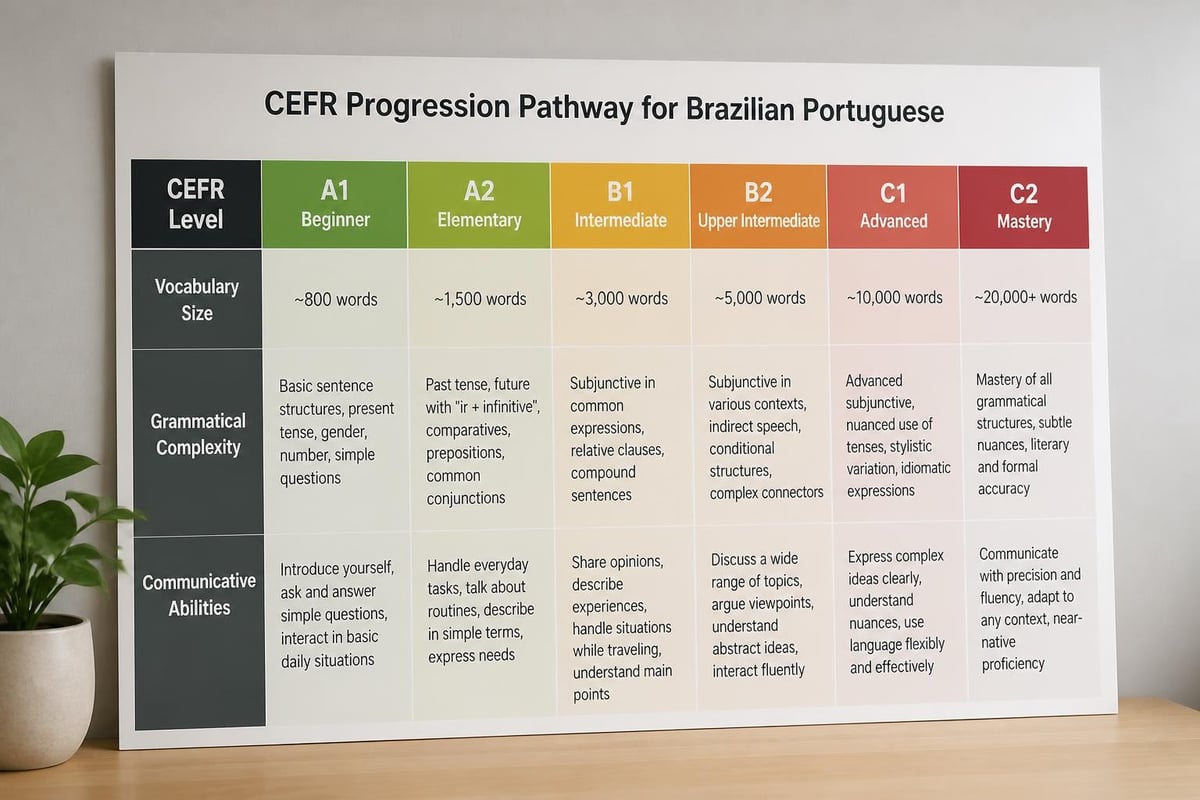
Brazilian Portuguese language learning benefits from clearly defined objectives and measurable progress indicators. The Common European Framework of Reference (CEFR) provides standardized benchmarks from A1 (beginner) through C2 (mastery), helping learners track advancement and set appropriate challenges.
Typical timeline expectations:
- A1 (3-4 months, 80-100 hours): Basic greetings, simple questions, essential vocabulary
- A2 (6-8 months total, 180-200 hours): Simple conversations, routine tasks, basic narration
- B1 (12-15 months total, 350-400 hours): Independent travel communication, expressing opinions, understanding main ideas
- B2 (18-24 months total, 500-600 hours): Professional contexts, complex discussions, spontaneous interaction
- C1 (30-36 months total, 700-800 hours): Academic and professional fluency, nuanced expression
- C2 (ongoing, 1000+ hours): Near-native proficiency across all contexts
These estimates assume consistent study with varied input and regular speaking practice. Individual results vary based on prior language learning experience, native language similarities and learning intensity.
Common Challenges and Solutions
Every learner encounters obstacles during brazilian portuguese language learning. Recognizing common difficulties and implementing targeted strategies prevents discouragement and maintains momentum toward fluency goals.
Overcoming the Listening Comprehension Barrier
Brazilian Portuguese spoken at natural speed challenges intermediate learners who understand written text comfortably. Connected speech features including vowel reduction, consonant assimilation and rapid delivery create comprehension gaps.
Proven listening improvement strategies:
- Start with slower pedagogical materials designed for learners
- Use transcripts initially, then remove them for pure listening practice
- Focus on one dialect initially before expanding to regional varieties
- Practice with short clips repeatedly rather than long content once
- Develop comfort with ambiguity and inference from context
Academic research on Portuguese language teaching methodologies emphasizes graded exposure and recursive practice for building listening proficiency. Learners benefit from materials slightly above their current level combined with strategic scaffolding.
Navigating Gender Agreement
Portuguese nouns carry grammatical gender that doesn't always align with biological gender or follow predictable patterns. Agreement extends beyond articles to adjectives, pronouns and past participles, creating multiple points where errors occur.
| Word Type | Masculine Example | Feminine Example | Agreement Rule |
|---|---|---|---|
| Noun + Article | o livro (the book) | a mesa (the table) | Article matches noun gender |
| Noun + Adjective | livro interessante | mesa interessante | Adjective matches noun gender |
| Compound | o livro é interessante | a mesa é interessante | Predicate adjective agrees with subject |
| Past Participle | Ele tem comprado | Ela tem comprada* | Limited agreement in compound tenses |
*Note: Brazilian Portuguese shows less past participle agreement variation than European Portuguese in many contexts.
Pattern recognition improves with exposure. Most words ending in -o are masculine whilst -a endings typically indicate feminine nouns, though important exceptions exist (o dia, o problema, a mão).
Speaking Practice and Confidence Building
Active speaking practice transforms passive knowledge into functional communication ability. Brazilian portuguese language learning requires regular verbal production despite initial discomfort and inevitable errors.
Conversation partners, language exchange platforms and structured speaking sessions provide essential practice opportunities. Native speakers generally appreciate learners' efforts and offer helpful corrections when approached respectfully.
Developing Natural Fluency
Fluency develops through extensive comprehensible input combined with meaningful output opportunities. Learners progress from careful, translated speech toward more automatic, natural expression as neural pathways strengthen through repetition.
Fluency-building activities include:
- Shadowing native speakers by immediately repeating their words
- Recording yourself and comparing to native speaker models
- Describing daily activities aloud in Portuguese
- Participating in online conversation groups
- Using Portuguese for internal monologue and thinking
Studies on dialectal variation and phonology demonstrate that exposure to diverse speakers improves overall fluency and comprehension. Learners who interact with multiple dialects develop more robust communication skills than those limited to single-dialect exposure.
Maintaining Long-term Motivation
Sustained brazilian portuguese language learning requires intrinsic motivation beyond initial enthusiasm. Connecting language study to personal values, meaningful relationships and concrete life goals maintains commitment through inevitable plateaus and challenges.
Celebrating small victories, tracking measurable progress and engaging with Brazilian culture beyond textbooks sustains motivation during the intermediate plateau where advancement feels slower. Finding Portuguese-speaking communities, whether online or locally, provides accountability and social reinforcement.
Motivation maintenance strategies:
- Connect learning to specific life goals (career advancement, family communication, relocation plans)
- Create daily habits rather than relying on sporadic intensive study
- Engage with content you genuinely enjoy in Portuguese rather than purely pedagogical materials
- Join learning communities for accountability and shared experience
- Acknowledge progress regularly through testing, recording speaking samples and reviewing earlier materials
Language acquisition research consistently shows that learners who integrate Portuguese into daily life through media consumption, hobbies and social interaction achieve better outcomes than those who treat it as isolated study separate from lived experience.
Professional and Personal Applications
Brazilian Portuguese language learning delivers tangible benefits across professional and personal domains. Business professionals gain competitive advantages in Latin American markets, whilst retirees planning relocation to Portugal or Brazil navigate bureaucracy and build community connections more effectively. Families with Brazilian heritage reconnect with cultural roots and communicate across generations.
Academic opportunities expand for students seeking exchange programmes at Brazilian universities or research collaborations with Portuguese-speaking scholars. Healthcare providers serving immigrant communities deliver better patient care through direct communication rather than translator mediation.
The language skills developed through systematic study extend beyond immediate practical applications to enhance cognitive flexibility, cultural competence and global awareness valuable throughout life.
Mastering Brazilian Portuguese requires strategic planning, consistent practice and engagement with authentic materials that bring the language to life beyond textbooks. Whether pursuing professional opportunities, planning relocation or deepening cultural connections, systematic instruction accelerates progress whilst building confidence across speaking, listening, reading and writing skills. Mi Casa of Languages offers accredited, flexible instruction designed to fit your schedule and goals, providing expert guidance backed by a proven track record of success. Start your Brazilian Portuguese journey today with professional support that adapts to your unique needs and timeline.





Recent Comments