



Learning Spanish opens doors to communication with over 500 million speakers worldwide, enriching both personal and professional opportunities. Whether you're preparing for travel, advancing your career, or connecting with heritage, finding the right spanish help makes all the difference between frustration and success. The journey to fluency requires more than textbooks; it demands strategic guidance, personalised support, and access to quality resources that fit your schedule and learning style.
Understanding Your Spanish Learning Needs
Every learner begins their Spanish journey from a unique starting point. Your previous language experience, learning preferences, and specific goals shape the kind of spanish help that will serve you best.
Beginners typically need foundational support covering pronunciation, basic grammar structures, and essential vocabulary. The first few months establish habits that influence long-term success, making qualified instruction particularly valuable during this phase.
Intermediate learners often struggle with plateaus where progress feels slower. At this stage, spanish help should focus on expanding conversational fluency, mastering verb tenses, and building confidence in real-world situations.
Advanced students require refined support targeting nuanced grammar, regional variations, and professional or academic language. The complexity increases, demanding instructors who can explain subtle distinctions and cultural contexts.
| Learning Level | Primary Challenges | Effective Support Types |
|---|---|---|
| Beginner | Pronunciation, basic structures, vocabulary | Structured courses, pronunciation guides, foundational grammar |
| Intermediate | Conversation fluency, verb conjugation, plateaus | Conversation practice, targeted grammar, authentic materials |
| Advanced | Nuanced usage, professional vocabulary, cultural subtleties | Specialised tutoring, immersion experiences, professional content |

Identifying Your Learning Style
Understanding how you absorb information best shapes the spanish help you seek. Visual learners benefit from charts, infographics, and written materials. Auditory learners thrive with podcasts, music, and conversation-focused practice. Kinesthetic learners need interactive activities, role-playing, and hands-on experiences.
Research on vocabulary learning effectiveness demonstrates that multiple exposure types reinforce retention. Combining visual, auditory, and practical application accelerates progress regardless of your primary preference.
Professional Spanish Instruction vs Self-Study
The debate between formal instruction and independent learning continues, yet evidence increasingly favours structured spanish help for most learners. Professional guidance provides accountability, error correction, and personalised feedback that self-study cannot replicate.
Benefits of Accredited Language Schools
Accredited institutions offer systematic curricula developed by language acquisition specialists. Qualified instructors identify pronunciation errors you might not hear yourself, explain grammar patterns that confuse self-learners, and adjust teaching methods to your progress.
Quality accreditation ensures consistency, professional standards, and recognition for your achievements. Schools registered with educational authorities maintain rigorous standards that protect your investment of time and resources.
Research on bilingual programme effectiveness confirms that structured, evidence-based instruction produces measurably better outcomes than unguided exposure. This applies equally to adults and young learners seeking spanish help.
- Structured progression ensures you build skills in logical sequence
- Expert error correction prevents fossilisation of mistakes
- Recognised certification provides credentials for academic or professional purposes
- Flexible scheduling accommodates working professionals and busy families
Self-study complements formal instruction but rarely replaces it entirely. Apps and online resources work brilliantly for vocabulary practice and maintaining skills between lessons, yet struggle to develop conversational fluency or correct subtle errors.
Choosing the Right Spanish Course Format
Modern spanish help comes in various formats, each offering distinct advantages. Your choice depends on learning goals, budget, schedule flexibility, and personal preferences.
Online Spanish Courses
Digital platforms have revolutionised language education, making quality spanish help accessible worldwide. Online courses eliminate geographical barriers, reduce costs, and offer unprecedented scheduling flexibility.
For professionals, expatriates, or those in areas without local language schools, Spanish and Portuguese online language courses deliver expert instruction tailored to individual schedules and goals. This format particularly suits travellers preparing for relocation, entrepreneurs building international connections, and families maintaining heritage languages.

Video conferencing technology enables real-time conversation practice with native speakers. Screen sharing allows instructors to present materials visually whilst maintaining the personal connection crucial for language learning.
Key advantages of online learning:
- Access to specialised instructors regardless of location
- Reduced costs without commuting or facility overhead
- Scheduling flexibility around work and family commitments
- Digital resources instantly available for review
- One-on-one attention at affordable rates
In-Person vs Virtual Instruction
Both formats deliver results when quality instruction guides the experience. In-person classes offer face-to-face interaction and immediate physical presence, whilst virtual sessions provide convenience and broader instructor selection.
The most effective approach often combines formats. Regular live sessions (online or in-person) provide structure and accountability, supplemented by independent practice using apps, reading materials, and media consumption.

Essential Components of Effective Spanish Help
Quality spanish help addresses multiple skill areas simultaneously rather than focusing narrowly on grammar or vocabulary alone. Language acquisition requires integrated development across listening, speaking, reading, and writing.
Pronunciation and Phonetics
Spanish pronunciation appears deceptively simple to English speakers, yet subtle distinctions significantly impact comprehension. The rolled 'r', vowel purity, and regional variations require targeted practice and expert feedback.
Resources like comprehensive pronunciation dictionaries document dialectal variants and phonetic patterns across Spanish-speaking regions. Understanding these variations prepares learners for real-world communication beyond textbook examples.
Professional spanish help includes systematic pronunciation training from the beginning. Early attention to sound production prevents ingrained errors that become difficult to correct later.
Grammar Mastery
Spanish grammar challenges English speakers through gendered nouns, subjunctive mood, and complex verb conjugations. Effective instruction breaks these concepts into manageable segments whilst building practical usage skills.
Priority grammar concepts:
- Present tense mastery before tackling past tenses
- Ser vs estar distinction through contextual practice
- Subjunctive mood introduced gradually with common phrases
- Prepositions learned through fixed expressions rather than translation
- Gender agreement reinforced through pattern recognition
Rushing through grammar creates confusion, whilst dwelling too long delays conversational practice. Quality spanish help balances systematic grammar instruction with immediate application in realistic contexts.
Building Practical Communication Skills
Grammar knowledge means little without the ability to use Spanish in real conversations. The best spanish help prioritises communicative competence alongside technical accuracy.
Conversation Practice Strategies
Regular speaking practice transforms passive knowledge into active fluency. This requires more than memorising phrases; true conversation demands thinking in Spanish rather than translating from English.
Effective conversation practice includes:
- Structured dialogue practice covering common situations (ordering food, asking directions, making appointments)
- Free conversation on topics matching your interests and proficiency level
- Error correction balanced with fluency encouragement
- Vocabulary expansion through contextual introduction during discussions
- Cultural context explaining why native speakers phrase ideas particular ways
Studies on early vocabulary interventions demonstrate that interactive, meaning-focused activities produce stronger retention than rote memorisation. This principle applies across age groups seeking spanish help.
Immersion Techniques
Total immersion in Spanish-speaking countries accelerates learning but isn't practical for everyone. Creating immersive experiences at home provides similar benefits through strategic choices.
Daily immersion practices:
- Change device languages to Spanish
- Listen to Spanish podcasts during commutes
- Watch Spanish-language television with Spanish subtitles
- Read news from Spanish-language sources on topics you already follow
- Join online communities discussing your hobbies in Spanish
Quality spanish help guides you in selecting appropriate materials for your level. Beginners need simplified content, whilst advanced learners benefit from authentic materials designed for native speakers.
Specialised Spanish Support for Specific Goals
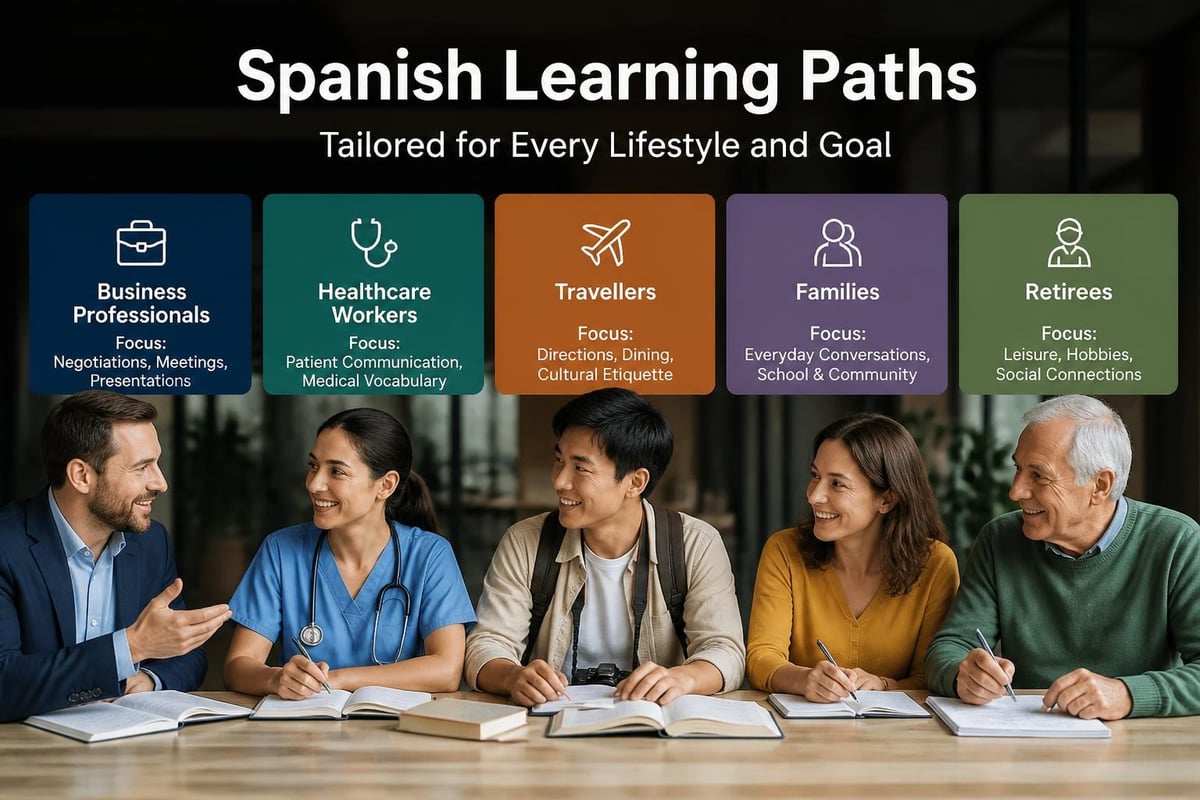
Different objectives require tailored spanish help approaches. Business professionals need different vocabulary and contexts than retirees relocating or families maintaining heritage connections.
Medical and Professional Spanish
Healthcare workers, legal professionals, and business people require specialised terminology and cultural competence. Standard courses provide insufficient preparation for professional contexts where precision matters.
Resources like MedlinePlus en español demonstrate the level of clarity and accuracy required for professional communication. Medical spanish help must cover not just vocabulary but cultural health beliefs and communication styles.
| Professional Field | Specialised Vocabulary Needs | Cultural Considerations |
|---|---|---|
| Healthcare | Medical terminology, symptom descriptions, treatment explanations | Health beliefs, family involvement in decisions, communication norms |
| Business | Industry-specific terms, negotiation language, formal correspondence | Business etiquette, hierarchy awareness, regional business practices |
| Legal | Contracts, court terminology, rights and procedures | Legal system differences, formality levels, documentation standards |
| Education | Curriculum vocabulary, parent communication, assessment language | Educational system variations, parent expectations, student-teacher dynamics |
Spanish for Travel and Relocation
Travellers and expatriates need practical spanish help focused on survival skills and cultural integration rather than academic proficiency. This includes navigation, shopping, housing, healthcare access, and social interaction.
Golden Visa families relocating to Spanish-speaking countries benefit from courses addressing both language and cultural adaptation. Children often acquire language faster than parents, creating unique family dynamics that quality instruction anticipates and addresses.
The Mi Casa of Languages blog offers guidance on various learning scenarios and cultural topics relevant to Spanish students worldwide.
Technology Tools Supporting Spanish Learning
Modern spanish help leverages technology to enhance traditional instruction methods. Digital tools provide practice opportunities, immediate feedback, and engaging content that maintains motivation.
Language Learning Applications
Mobile apps supplement formal instruction by providing convenient practice during small gaps in your day. They excel at vocabulary drilling, basic grammar exercises, and maintaining streaks that build habits.
However, apps alone rarely produce fluency. They work best as practice tools supporting spanish help from qualified instructors who provide conversation practice, error correction, and cultural context.
Effective app usage strategies:
- Use apps for daily vocabulary review between lessons
- Focus on listening and pronunciation features
- Avoid apps that emphasise translation over contextual learning
- Track progress to identify weak areas needing instructor attention
- Set modest daily goals that maintain consistency without burnout
Online Resources and Communities
The internet offers unprecedented access to Spanish media, conversation partners, and learning communities. Curating quality resources prevents overwhelm and ensures your practice time produces results.
Native content designed for Spanish speakers challenges advanced learners appropriately. News sites, YouTube channels, and podcasts on topics you already enjoy make language practice feel less like work.
Online conversation exchanges connect you with native speakers seeking english practice. Whilst valuable, these informal arrangements lack the structure and pedagogical expertise of professional spanish help.
Overcoming Common Spanish Learning Challenges
Every learner encounters obstacles during their Spanish journey. Recognising common difficulties and knowing proven solutions prevents discouragement and maintains progress.
The Plateau Effect
Intermediate learners frequently experience frustrating plateaus where progress stalls despite consistent effort. This natural phase occurs as you transition from learning basic structures to developing nuanced fluency.
Breaking through plateaus requires strategic spanish help addressing specific weak points. Diagnostic assessments identify whether vocabulary gaps, grammar confusion, or limited practice opportunities create the bottleneck.
Plateau-breaking strategies:
- Increase conversation practice focusing on fluency over accuracy temporarily
- Expand input variety through different media types and topics
- Study advanced grammar in small doses to expand expression range
- Set specific, measurable goals beyond general "improve my Spanish" intentions
- Track progress objectively through recordings, tests, or external assessments
Verb Conjugation Complexity
Spanish verb conjugations overwhelm many learners with their quantity and irregularities. Effective spanish help introduces conjugations systematically, focusing on high-frequency patterns before rare irregulars.
Memorisation alone fails; understanding usage patterns and practising in context produces retention. Quality instruction connects conjugations to communication purposes rather than treating them as isolated grammar exercises.
Regional Variation Concerns
Spanish varies significantly across countries and regions, causing learners to worry about learning the "wrong" version. This concern, whilst understandable, shouldn't paralyse your learning.
Addressing regional variation:
- Focus initially on standard Spanish shared across regions
- Choose regional focus matching your specific goals (Spain for European travel, Mexican Spanish for North American contexts)
- Recognise that core grammar and vocabulary remain consistent across variants
- View regional differences as enrichment rather than obstacles
- Trust that native speakers accommodate learners regardless of slight regional mismatches
Professional spanish help from qualified schools ensures you learn widely understood Spanish whilst acknowledging regional preferences where relevant.
Maintaining Long-Term Spanish Progress
Achieving conversational fluency requires months or years of consistent effort. The spanish help you choose must support not just initial learning but sustained engagement preventing skill erosion.
Creating Sustainable Practice Routines
Consistency matters more than intensity for language acquisition. Daily 20-minute practice sessions produce better results than occasional marathon study sessions.
Building sustainable habits:
- Schedule practice at consistent times when you're mentally alert
- Stack language practice onto existing habits (Spanish podcasts during morning coffee)
- Set minimum daily goals low enough to maintain even during busy periods
- Vary practice types to prevent boredom and engage different skills
- Celebrate milestones to maintain motivation through the inevitable challenges
The course offerings from accredited schools typically include ongoing support options that maintain momentum beyond initial intensive study periods.
Measuring Progress Effectively
Tracking progress objectively helps maintain motivation and identify areas needing additional spanish help. Subjective feelings about your abilities often lag behind actual improvement or exaggerate temporary setbacks.
| Assessment Method | What It Measures | Frequency Recommendation |
|---|---|---|
| Formal proficiency tests | Overall level against standard benchmarks | Every 6-12 months |
| Conversation recordings | Fluency, pronunciation, natural expression | Monthly |
| Written compositions | Grammar accuracy, vocabulary range, organisation | Bi-weekly |
| Comprehension exercises | Listening and reading understanding | Weekly |
| Vocabulary tests | Active recall of studied terms | After each lesson/unit |
Regular assessment within your spanish help programme ensures you're progressing toward goals and helps instructors adjust teaching strategies to your evolving needs.
Investment Considerations for Spanish Learning
Quality spanish help represents an investment of both time and money. Understanding typical costs and expected timelines helps you plan realistically and choose options matching your budget.
Cost-Benefit Analysis
Language skills provide lifelong value through enhanced travel experiences, career opportunities, cultural connections, and cognitive benefits. Comparing costs to these long-term returns justifies investment in quality instruction.
Budget allocation priorities:
- Professional instruction as the foundation (group classes or individual tutoring)
- Core textbooks and materials recommended by your programme
- Supplementary resources (apps, subscriptions) that enhance but don't replace instruction
- Immersion experiences when feasible (travel, local Spanish-speaking events)
- Assessment and certification for academic or professional credential purposes
Affordable options exist without sacrificing quality. Accredited schools offering flexible online formats reduce costs whilst maintaining professional standards through association with universities and government registration.
Time Investment Requirements
Reaching conversational fluency typically requires 600-750 hours of study and practice for English speakers learning Spanish. This translates to different timelines depending on daily commitment.
Realistic timeframes:
- 30 minutes daily: 3-4 years to conversational fluency
- 1 hour daily: 2 years to conversational fluency
- 2 hours daily: 1 year to conversational fluency
- Intensive immersion: 6-9 months to conversational fluency
These estimates assume quality spanish help guiding your practice. Unfocused self-study requires significantly more time to achieve similar results.
Accessing the main services offered by established language schools provides clear curriculum maps showing progression timelines tailored to different intensity levels and goals.
The Role of Cultural Understanding in Language Success
Language and culture intertwine inseparably. Effective spanish help addresses not just grammar and vocabulary but the cultural contexts that give language meaning and purpose.
Cultural Competence Development
Understanding cultural norms, values, and communication styles transforms you from someone who speaks Spanish to someone who truly connects with Spanish speakers. This knowledge prevents misunderstandings and deepens relationships.
Essential cultural learning areas:
- Communication styles (directness levels, politeness conventions, small talk expectations)
- Social customs (greetings, personal space, meal etiquette, gift-giving)
- Values and worldviews (family structures, time orientation, individualism vs collectivism)
- Regional differences (Latin American vs European Spanish cultures, national variations)
- Current events and history (understanding references native speakers consider common knowledge)
Quality spanish help incorporates cultural instruction naturally throughout language lessons rather than treating it as separate or optional content.
Avoiding Cultural Missteps
Even fluent Spanish speakers offend unintentionally without cultural awareness. Professional instruction prevents common mistakes that damage relationships or create embarrassment.
Formal vs informal address (tú vs usted) varies significantly across Spanish-speaking countries. Using the wrong form signals disrespect or inappropriate familiarity. Similarly, literal translation of English politeness strategies often sounds awkward or rude in Spanish contexts.
Instructors with deep cultural knowledge guide you through these subtleties, explaining not just what to say but why native speakers make particular linguistic choices.
Effective spanish help combines professional instruction, strategic practice, quality resources, and cultural understanding to transform your language abilities and open new opportunities. Whether you're pursuing career advancement, planning international relocation, maintaining family heritage, or simply enriching your life through new connections, the right support system accelerates your progress whilst building confidence and enjoyment in the learning process. Mi Casa of Languages delivers accredited, flexible Spanish courses tailored to your schedule and goals, with a proven track record of 100% success supporting students throughout South Africa and worldwide.





Recent Comments