


The enduring appeal of Latin lies in its foundational role in Western civilisation, its influence on modern Romance languages and its unmatched utility for students of law, medicine, theology and classical literature. A well-structured latin language course offers far more than the ability to translate ancient texts; it cultivates analytical thinking, enriches vocabulary and provides a gateway to understanding European culture, history and linguistic evolution. Whether you are a secondary-school learner preparing for university, a professional seeking to deepen your understanding of legal or medical terminology, or a lifelong learner drawn to the intellectual challenge, modern Latin instruction has evolved to meet diverse needs through blended pedagogy, digital resources and flexible delivery models.
Core Components of a Latin Language Course
Every effective latin language course builds competency across four interconnected domains: grammar and morphology, vocabulary acquisition, translation skills and cultural context. Grammar instruction forms the backbone of early study, introducing learners to the five noun declensions, four principal parts of verbs, and the complex system of tenses, moods and voices that govern Latin syntax. Students progress from simple Subject-Verb-Object sentences to mastering subordinate clauses, indirect statements and the ablative absolute.
Vocabulary development follows two parallel tracks:
- High-frequency core vocabulary (the 500-1,000 most common words) for immediate reading fluency
- Thematic lexical sets organised by semantic fields (family, government, warfare, philosophy)
- Etymology exercises connecting Latin roots to English derivatives
- Principal-part memorisation for systematic verb conjugation
Translation practice moves methodically from constructed sentences designed to reinforce specific grammatical concepts to authentic excerpts from canonical authors. Beginners typically encounter adapted passages from Caesar's Commentarii de Bello Gallico or Nepos's De Viris Illustribus, whilst intermediate students tackle unadapted Cicero, Vergil and Ovid. Advanced courses engage with historiography (Livy, Tacitus), satire (Horace, Juvenal) and philosophy (Seneca, Lucretius).

Modern Pedagogical Approaches
Traditional grammar-translation methodology has been enriched in recent years by communicative techniques, comprehensible input strategies and technology integration. The Cambridge Journal of Classics Teaching published research in 2024 demonstrating that digital parsing tools significantly improve student comprehension and translation accuracy when integrated with traditional instruction.
Many contemporary courses now incorporate:
- Spoken Latin exercises for internalising syntax patterns
- Timed parsing drills using web-based platforms
- Collaborative translation projects with peer review
- Multimedia cultural presentations exploring Roman daily life, architecture and political institutions
- Comparative linguistics modules tracing Latin's evolution into Italian, Spanish, Portuguese, French and Romanian
The Scaife Viewer exemplifies how digital tools transform classical text engagement, offering side-by-side editions, annotations and morphological analysis that support independent reading practice. Such platforms have become integral to hybrid and online latin language course delivery.
Cognitive and Academic Benefits
Research consistently demonstrates that Latin study enhances performance across multiple cognitive domains. Students who complete a structured latin language course show measurable improvements in:
| Cognitive Domain | Documented Benefit | Mechanism |
|---|---|---|
| Verbal reasoning | 15-20% score increase on standardised tests | Systematic parsing strengthens analytical reading |
| Vocabulary acquisition | 30% larger English vocabulary | Direct etymology knowledge and morphological awareness |
| Foreign language aptitude | Faster Romance language acquisition | Explicit grammatical metalanguage and pattern recognition |
| Logical reasoning | Enhanced deductive skills | Inflectional analysis requires sequential logic |
These advantages explain Latin's enduring popularity among students preparing for law, medicine and academic careers. Legal professionals benefit from immediate comprehension of terms like habeas corpus, res ipsa loquitur and stare decisis, whilst medical students recognise anatomical nomenclature and pharmaceutical terminology rooted in Latin and Greek compounds.
The metacognitive benefits extend beyond vocabulary. Because Latin requires conscious attention to word endings, syntactic relationships and contextual clues, students develop transferable analytical habits applicable to reading comprehension, mathematical problem-solving and scientific reasoning.
Secondary and Tertiary Pathways
School-based Latin programmes typically follow one of three models: traditional four-year sequences culminating in Advanced Placement or International Baccalaureate examinations, accelerated two-year intensive tracks for upper-secondary students, or elective modules integrated within classical civilisation courses. The National Latin Exam provides standardised assessment benchmarks across six proficiency levels, from Introduction to Latin through to Latin VI/Vergil.
University latin language course offerings range from elementary sequences for students with no prior exposure through to graduate seminars in specialised topics such as Silver Age literature, late antique Christian texts or medieval Latin palaeography. Many institutions offer summer intensive programmes that compress a full year's curriculum into eight weeks of immersive study.
Curriculum Design and Resource Selection
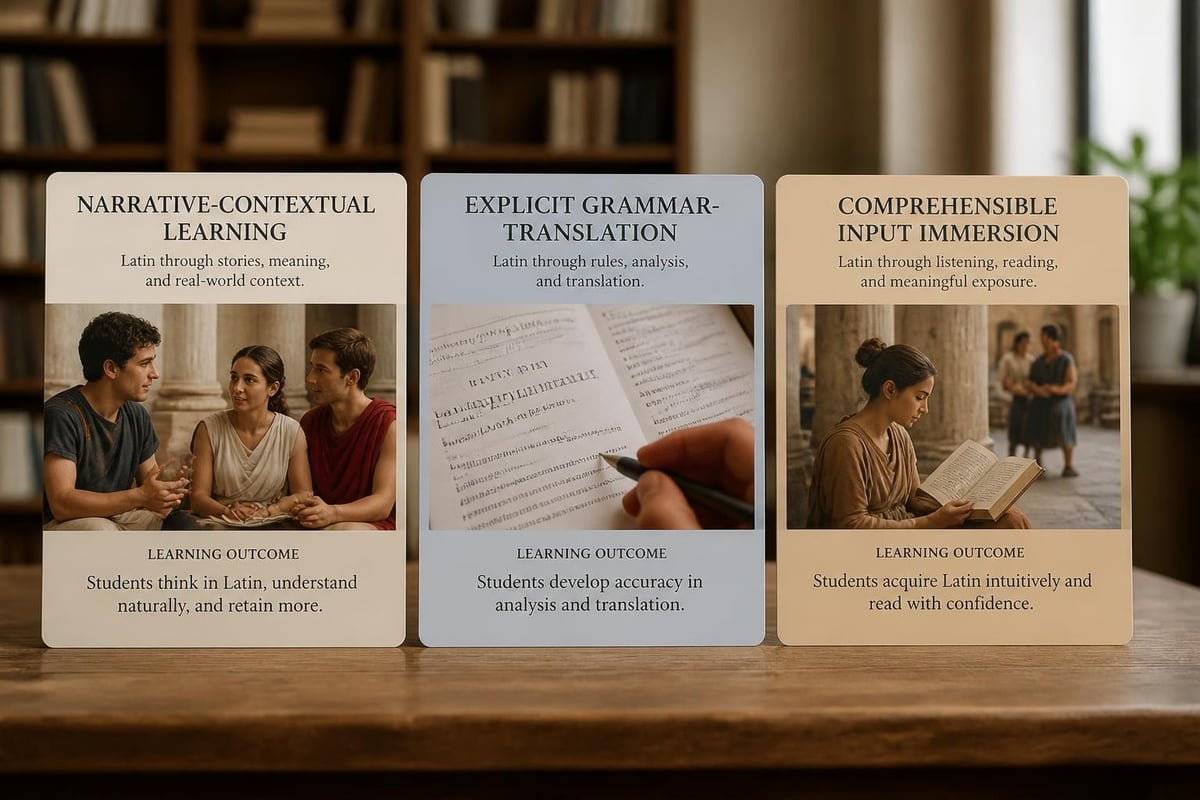
Effective course design balances systematic grammar presentation with engaging textual material and cultural enrichment. The most widely adopted textbooks in 2026 include the Cambridge Latin Course (narrative-based, contextualised learning), Wheelock's Latin (traditional paradigm-focused approach), and Lingua Latina per se Illustrata (immersive comprehensible input method). Each methodology offers distinct advantages:
Cambridge Latin Course embeds grammar within continuous narratives following the household of Caecilius in Pompeii, providing rich cultural context and intrinsic motivation through storytelling. Students acquire vocabulary and syntax inductively whilst engaging with archaeological evidence, social history and the eruption of Vesuvius.
Wheelock's Latin presents morphology and syntax through systematic paradigms, extensive drill exercises and graduated readings from classical authors. This explicit, deductive approach suits learners who prefer clear rule statements and structured practice before encountering authentic texts.
Lingua Latina per se Illustrata employs comprehensible input principles, presenting only Latin text with meaning clarified through context, illustrations and marginal glosses. Students develop reading fluency through extensive exposure to carefully graded prose before formal grammar explanation.
Supplementary Materials and Digital Resources
Beyond core textbooks, successful courses incorporate diverse supplementary materials:
- Primary text readers with commentary (Oxford, Cambridge and Bristol Classical Press series)
- Grammar reference works (Allen & Greenough, Gildersleeve & Lodge)
- Vocabulary tools (spaced-repetition flashcard systems, frequency dictionaries)
- Audio recordings for pronunciation modelling and aural comprehension
- Virtual reality reconstructions of Roman sites and historical events
The Open Greek and Latin project maintains TEI-encoded digital editions of the entire classical corpus, enabling sophisticated text analysis, concordance searching and comparative manuscript study. These open-access resources democratise access to scholarly editions previously available only in research libraries.
For K-12 educators, the American Classical League provides professional development, curriculum materials and the REDI (Resources for Equity, Diversity, and Inclusion) collection addressing representation in classical studies. The Ohio Department of Education’s Latin resources offer vetted lesson plans, unit templates and assessment rubrics aligned with World-Readiness Standards.
Assessment and Certification
A comprehensive latin language course employs multiple assessment modalities to evaluate student progress across interpretive, analytical and productive skills. Formative assessments include:
- Weekly vocabulary quizzes (recognition and production)
- Grammar mastery checks (paradigm recitation, sentence composition)
- Sight translation exercises (unseen passages with lexical support)
- Error analysis activities (identifying and correcting common mistakes)
Summative assessments typically comprise:
- Prepared translation examinations (passage studied in class, translated without notes)
- Sight reading assessments (unseen text of appropriate difficulty)
- Grammar and syntax analysis (parsing, labelling syntactic functions)
- Composition exercises (Latin prose or verse composition on classical models)
- Cultural knowledge examinations (Roman history, mythology, daily life)
| Assessment Type | Weighting Range | Primary Skill Evaluated |
|---|---|---|
| Prepared translation | 25-35% | Reading comprehension, vocabulary retention |
| Sight translation | 20-30% | Analytical parsing, grammatical application |
| Grammar tests | 15-25% | Morphological knowledge, syntactic understanding |
| Composition | 10-15% | Active language production, stylistic awareness |
| Cultural projects | 10-20% | Historical context, interdisciplinary synthesis |
External certification pathways include the National Latin Exam (recognition through national ranking and scholarships), Advanced Placement Latin (university credit potential), and the Classical Association of the Middle West and South teaching materials that prepare students for academic competitions and undergraduate placement examinations.
Specialised Course Tracks
Advanced students often pursue specialised latin language course tracks focusing on particular periods, genres or interdisciplinary applications:
Medieval Latin courses examine the evolution of classical Latin into the lingua franca of European scholarship, theology and law from 500-1500 CE. Students read Bede, Gregory of Tours, Thomas Aquinas and the Carmina Burana, developing facility with orthographic variants, neologisms and Christian theological vocabulary.
Legal Latin programmes serve law students and paralegals, concentrating on the terminology, maxims and documentary forms that persist in common-law jurisdictions. Participants analyse wills, contracts, court pleadings and legal treatises whilst mastering principles of Roman law foundational to modern jurisprudence.
Scientific Latin courses address the nomenclatural systems governing biology, botany, zoology and medicine. Students learn binomial classification, anatomical terminology and pharmaceutical conventions, often in coordination with undergraduate science programmes.

Online and Hybrid Delivery Models
The expansion of online education has transformed latin language course accessibility, enabling learners in remote locations or with scheduling constraints to pursue structured Latin study. Successful distance learning incorporates synchronous elements (live instruction via video conferencing, real-time parsing practice, collaborative translation workshops) and asynchronous components (recorded grammar lectures, self-paced vocabulary drills, discussion forums for textual interpretation).
Platforms offering comprehensive online Latin instruction typically feature:
- Interactive grammar modules with instant feedback on exercises
- Video demonstrations of pronunciation, scansion and recitation
- Virtual office hours for individualised support
- Peer collaboration tools for group translation projects
- Adaptive assessment systems adjusting difficulty based on performance
Whilst some language educators prefer face-to-face instruction for Latin, research indicates that well-designed online courses achieve comparable learning outcomes when they incorporate regular speaking/parsing practice, prompt feedback on written work and structured opportunities for synchronous interaction. Hybrid models combining weekly online instruction with monthly in-person intensive sessions have proven particularly effective for adult learners balancing work and study commitments.
Those seeking structured, accredited instruction in Romance languages descended from Latin may explore Spanish & Portuguese online Language courses that build practical communication skills whilst illuminating the historical linguistic connections to classical Latin. Understanding Latin's evolution into modern Romance languages enriches both classical study and contemporary language acquisition.

Selecting the Right Course Format
Prospective students should evaluate latin language course options according to several key criteria:
Learning objectives determine appropriate course level and focus. Students preparing for university classics programmes require comprehensive grammar coverage and extensive reading in poetry and prose, whilst professionals seeking terminology mastery for law or medicine benefit from targeted lexical study without full morphological paradigms.
Time commitment varies significantly across formats. Traditional secondary-school sequences allocate 3-5 hours weekly over four years, university elementary courses typically meet 4-5 hours weekly across two semesters, and summer intensives may require 20-25 hours weekly for six to eight weeks.
Instructional methodology preferences differ among learners. Those who excel with explicit rule presentation and systematic practice often prefer traditional grammar-translation courses, whilst learners who favour contextual acquisition and narrative engagement benefit from inductive approaches like the Cambridge Latin Course or comprehensible input methods.
Resource availability affects course sustainability. Students with access to academic libraries, native Latin speakers (primarily ecclesiastical contexts) or classical organisations benefit from supplementary support unavailable to isolated learners, making well-resourced online programmes particularly valuable for the latter group.
Assessment requirements matter for students seeking university credit, professional credentials or competition participation. Courses aligned with standardised examinations like the National Latin Exam or AP Latin provide structured preparation for external assessment, whilst independent study programmes may offer greater flexibility in pacing and focus areas.
Career and Academic Applications
Completion of a rigorous latin language course enhances qualifications across numerous career paths. Law and Legal Studies represent the most direct application, with Latin terminology pervading case law, statutory interpretation and legal education. Many law schools report that students with Latin backgrounds demonstrate superior performance in first-year contracts, torts and civil procedure courses.
Medicine and Health Sciences employ Latin (and Greek) nomenclature extensively in anatomy, physiology, pathology and pharmacology. Medical students with Latin training navigate technical terminology more efficiently, recognising roots, prefixes and suffixes that clarify anatomical relationships and disease processes.
Education and Academia value Latin proficiency for careers in classics, ancient history, archaeology, art history and comparative literature. Secondary positions teaching Latin remain available in independent schools, whilst university faculty positions typically require advanced graduate study in classics or a related field.
Library and Information Science professionals benefit from Latin knowledge when cataloguing rare books, managing special collections or conducting bibliographic research. Many primary sources in European history through the nineteenth century exist only in Latin.
Publishing and Editing roles in academic presses, particularly those specialising in classics, history or philosophy, favour candidates with Latin reading ability for manuscript evaluation and editorial work.
Beyond specific career applications, the analytical rigour and cultural literacy developed through Latin study signal intellectual capability, attention to detail and persistence, qualities valued across professional contexts. Students who complete a comprehensive latin language course demonstrate capacity for sustained engagement with complex material, systematic problem-solving and mastery of abstract grammatical concepts.
Mastering Latin unlocks profound insights into language structure, Western intellectual heritage and the linguistic foundations of modern European culture, whilst developing transferable analytical skills applicable across academic and professional domains. Whether you seek to deepen your understanding of Romance languages, explore classical literature in the original, or enhance your professional terminology in law or medicine, Mi Casa of Languages provides accessible, flexible instruction designed around your schedule and learning goals. Contact us to discover how our accredited programmes, delivered both in South Africa and worldwide, can support your language-learning ambitions.





Recent Comments