



To learn the Spanish language as a beginner, start with pronunciation and a small set of high-frequency phrases, study a little every day, and begin speaking within the first few weeks rather than waiting until you feel ready. Spanish is one of the more accessible languages for English speakers because its spelling is largely phonetic and much of its vocabulary overlaps with English. What it demands is consistency and a clear plan, which this guide sets out step by step.
Why Is Spanish Worth Learning Now?
Spanish is worth learning because demand for it is high, the language is widely spoken, and the skills carry across travel, work and family life. The 2025 Duolingo Language Report, based on learner activity between 1 October 2024 and 30 September 2025, ranked Spanish first among languages with the most engaged learners on the platform. That level of interest reflects practical motivation rather than fashion.
For learners in South Africa and elsewhere, the reasons tend to fall into a few groups:
- Travel and relocation: Spanish opens up Spain, Latin America and large communities in the United States.
- Career growth: Bilingual candidates stand out in trade, tourism, hospitality, law and customer service.
- Family and relationships: Many learners want to speak with a partner's relatives or a new community.
- Academic goals: Students often add Spanish to complement other studies.
Knowing your reason matters because it shapes what you study first. A traveller needs ordering, directions and small talk. A professional needs formal greetings, email phrases and industry vocabulary.
How Do I Begin to Learn Spanish?
The best way to begin is to set a specific goal, learn the sounds of the language, and build a first vocabulary of useful phrases before touching complicated grammar. Beginners who skip this groundwork often stall within weeks.
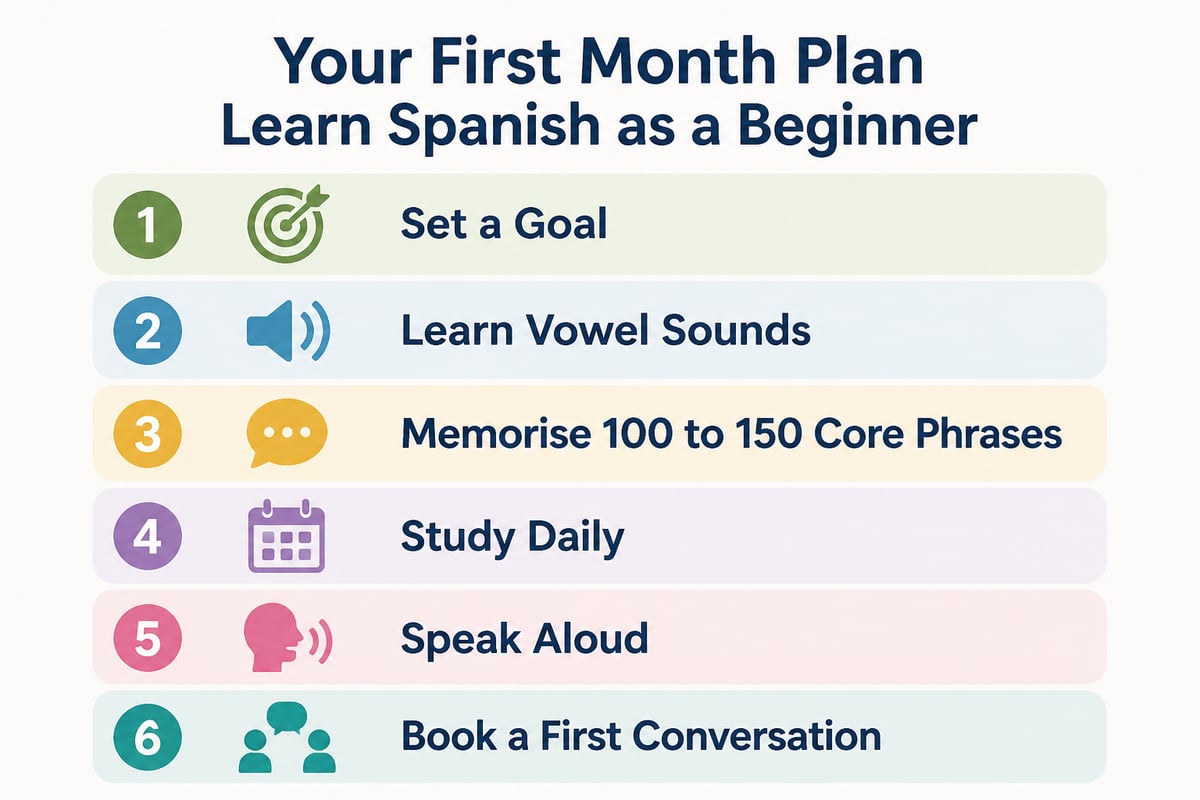
Follow this sequence for your first month:
- Define a concrete target. For example, "hold a five-minute introduction conversation in eight weeks."
- Learn the alphabet and vowel sounds. Spanish has five pure vowels, and mastering them early pays off in everything you say.
- Memorise 100 to 150 high-frequency words and phrases. Greetings, numbers, days, food, directions and common verbs cover most early situations.
- Study in short daily sessions. Fifteen to thirty minutes every day beats a three-hour session once a week.
- Say everything aloud. Reading silently builds recognition, but speech builds recall.
- Book a first conversation. Even a tutor-led chat of ten minutes exposes gaps that solo study hides.
What Does a Beginner Actually Need to Know?
A beginner needs to handle everyday expressions and simple statements about themselves, which is exactly what the A1 level describes. The Council of Europe's CEFR A1 descriptors state that learners at this stage can understand everyday expressions for concrete needs when speech is clear, slow and repeated, and can use a very basic range of simple expressions about personal details and concrete needs.
In practical terms, an A1 learner should be able to:
- Greet people and introduce themselves
- Give their name, age, nationality and occupation
- Order food and drink and ask for prices
- Ask for and understand simple directions
- Count, tell the time and name days and months
Treat this as your first milestone. It is modest, measurable and genuinely useful, and reaching it gives you a foundation for the intermediate stages that follow.
How Can I Improve My Spanish Pronunciation?
You can improve your Spanish pronunciation by learning the small set of consistent sound rules, listening closely to native speakers, and recording yourself so you can compare. Spanish is far more regular than English, so a few rules cover most words.
Focus on these points first:
- Vowels stay short and pure. The letter "a" is always like the "a" in "father", and "e", "i", "o" and "u" are equally steady.
- The "r" and "rr". A single "r" is a quick tap of the tongue, while "rr" is a rolled trill. Practise with words such as "pero" and "perro".
- Silent "h". The letter "h" is never pronounced in Spanish.
- "J" and "g" before "e" or "i". These produce a throaty sound similar to a soft "h".
- Stress patterns. Words ending in a vowel, "n" or "s" are stressed on the second-to-last syllable. Written accents mark exceptions.
A useful habit is shadowing. Play a short audio clip, pause after each sentence and repeat it, matching rhythm and intonation as closely as you can. Recording your attempt and playing it beside the original reveals differences you cannot hear while speaking.
Which Grammar Should Beginners Learn First?
Beginners should learn the present tense, the verbs "ser" and "estar", noun gender and agreement, and basic question forms before moving to more complex structures. Grammar is easier when you study it in service of communication rather than as isolated rules.
The essentials in order
Start with regular present-tense verbs ending in -ar, -er and -ir, because these patterns repeat across hundreds of verbs. Then add "ser" and "estar", both meaning "to be", which is the most common early stumbling block. "Ser" describes identity and permanent traits, while "estar" describes location and temporary states.
Next, learn that nouns are masculine or feminine and that adjectives change to match. After that, add "ir a" plus an infinitive for the near future ("voy a comer", "I am going to eat"), which gives you a simple way to talk about plans without learning the full future tense.
Delay the difficult material
The subjunctive, the full range of past tenses and complex pronoun placement can wait. Learners who tackle them in week two usually become discouraged. Cover them once you can speak comfortably in the present.
What Daily Routine Works Best for Learning Spanish?
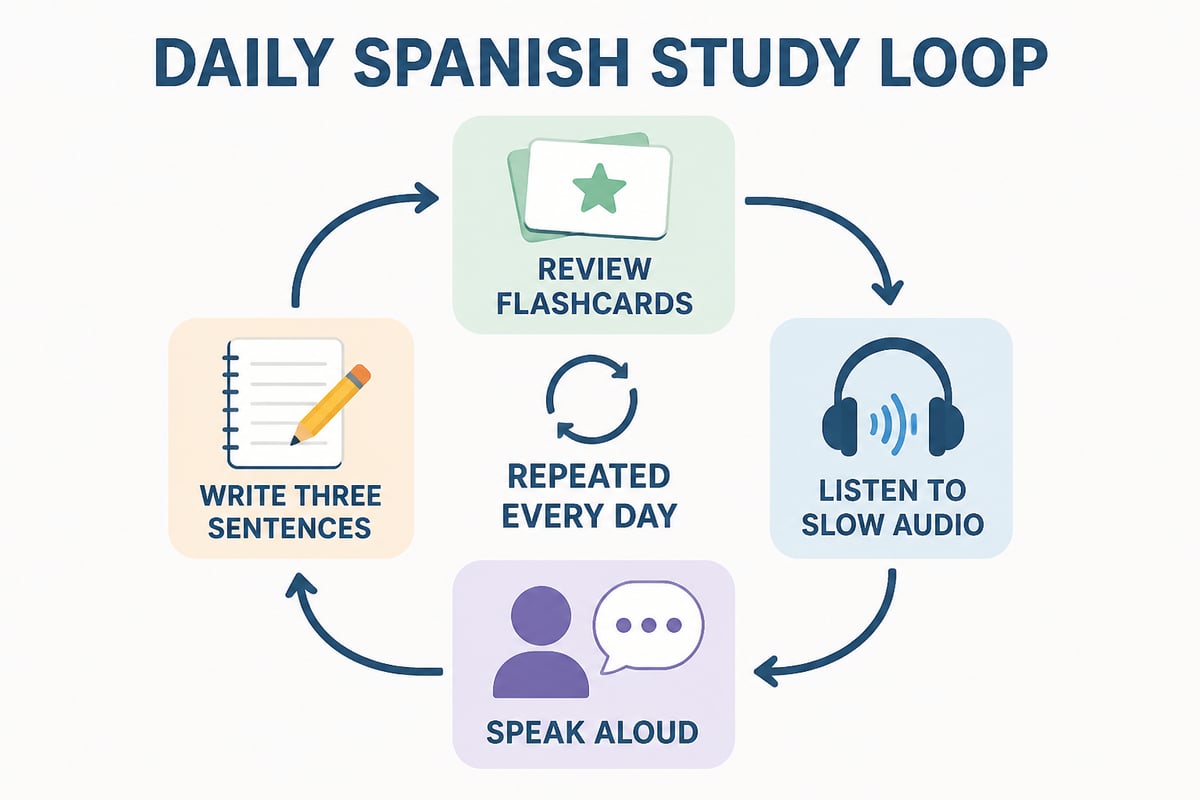
A routine that combines vocabulary, listening, speaking and a small amount of writing every day works best, because each skill reinforces the others. Variety also keeps motivation steady over months.
A balanced thirty-minute session might look like this:
| Block | Minutes | Activity |
|---|---|---|
| Review | 5 | Revisit yesterday's words with spaced-repetition flashcards |
| Input | 10 | Listen to slow, clear Spanish audio or watch subtitled video |
| Output | 10 | Speak aloud, answer prompts or talk with a tutor |
| Writing | 5 | Write three sentences about your day |
Little and often is the principle. If thirty minutes is unrealistic, ten minutes of focused study still builds momentum. The aim is to prevent long gaps, because forgetting accelerates when practice stops.
Anchor the habit to something you already do, such as a morning coffee or the commute. Habits tied to an existing cue are far easier to sustain than ones that rely on motivation alone.
How Should You Practise Speaking Before You Feel Ready?
You should practise speaking from the first weeks, using short, imperfect sentences, because confidence comes from use rather than from waiting. Most beginners delay speaking out of fear of mistakes, which slows progress considerably.
Try these low-pressure approaches:
- Talk to yourself. Describe what you are doing as you cook, tidy or walk.
- Use scripts. Prepare a short self-introduction and repeat it until it is automatic.
- Find a conversation partner or tutor. Live correction is the fastest way to fix recurring errors.
- Create a key event. Plan a trip, a dinner with Spanish-speaking friends or a video call, and work towards it. A deadline sharpens focus.
Mistakes are information. When a tutor corrects you, note the pattern and revisit it the next day. Over a few weeks the same errors appear less often, which is a clear sign of progress.
Can You Learn Spanish Language Skills Online, Including Free Options?
Yes, you can learn Spanish language skills online, and there are free options for adults alongside structured paid courses. Free resources are useful for vocabulary, listening and casual practice, but they rarely provide personal feedback or a clear progression.
Free tools typically include public podcasts, video channels, library apps and community conversation groups. They suit self-motivated learners who can build their own plan. The limitation is accountability: without a schedule or a teacher, many learners drift after the first few weeks.
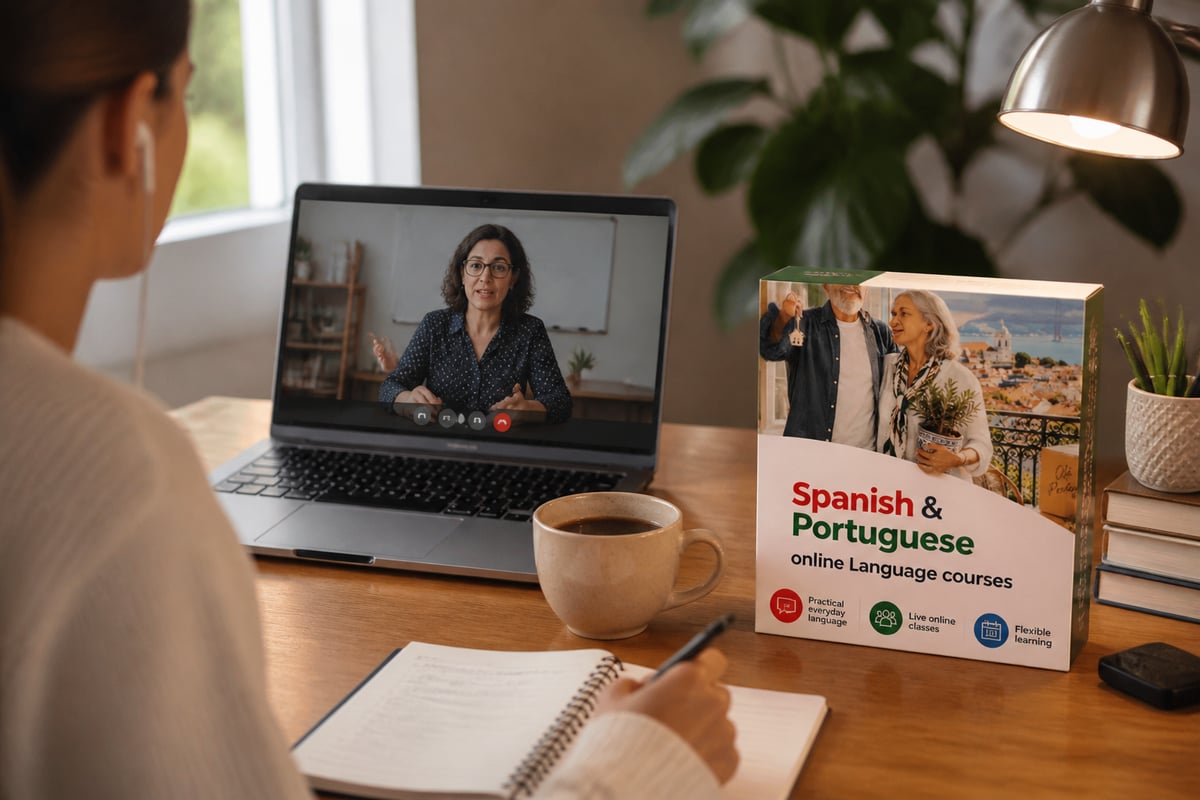
Structured courses add a defined curriculum, correction and a pace that matches your goals. Mi Casa of Languages offers Spanish and Portuguese online language courses designed for travellers, professionals, students, retirees and families, with sessions arranged around your availability. Contact the school directly for course details, structure and fees.
A sensible approach is to combine both: use free material for daily exposure and a guided course for structure and feedback.
What Mistakes Should Beginners Avoid?
Beginners should avoid collecting resources without using them, memorising word lists without context, and relying on one skill. These habits feel productive but produce slow results.
The most common problems are:
- Switching methods constantly. Constant change means no method ever has time to work.
- Translating word for word. Spanish word order and idioms differ from English, so learn whole phrases instead.
- Neglecting listening. Reading ability alone does not prepare you for real speech, which is faster and less clear.
- Chasing a perfect accent before communicating. Clear and understood is a better early goal than flawless.
- Believing in a single magic method. No app or technique replaces consistent practice combined with feedback.
One further point is worth building into your plan: keep a short error log. Each week, write down the three mistakes you made most often and a corrected example of each. Reviewing this log takes five minutes and targets your own weaknesses rather than generic advice.
How Long Does It Take, and Can You Study Spanish at University Level Online?
Reaching a confident A1 to A2 level typically takes a few months of regular study, while conversational fluency takes considerably longer and depends on hours practised, not calendar time. Your pace depends on how many weekly hours you can commit and how early you begin speaking.
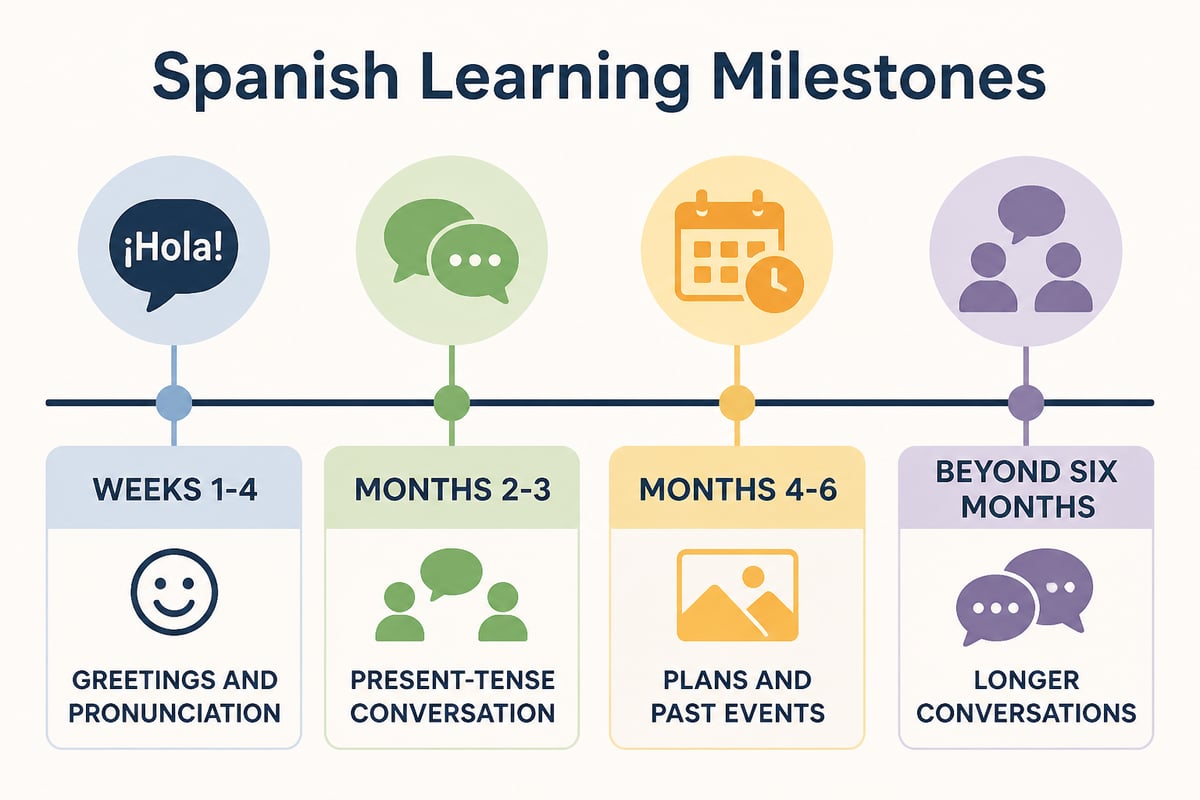
Set milestones in stages rather than aiming for vague fluency:
- Weeks 1 to 4: pronunciation, greetings, numbers and a first self-introduction.
- Months 2 to 3: present-tense conversation about daily life, simple questions and short exchanges.
- Months 4 to 6: talking about plans and past events, understanding slow native speech.
- Beyond six months: longer conversations, authentic media and more complex grammar.
These are guides, not guarantees. If you later want formal recognition or academic study, check what accredited options exist and how they align with university programmes. Contact the school to discuss how its courses relate to your academic or professional goals.
FAQ
Is Spanish hard for English speakers?
Spanish is generally considered one of the easier languages for English speakers. Spelling follows consistent rules and many words share Latin roots with English. The main challenges are verb conjugation, noun gender and the rolled "r".
Do I need to live in a Spanish-speaking country to become fluent?
No. Regular speaking practice with a tutor or partner, daily listening and structured study can take you a long way from home. Immersion speeds things up, but deliberate practice matters more than location.
How many hours a week should a beginner study?
A realistic target is three to five hours a week, split into short daily sessions. Consistency matters more than volume, so choose an amount you can maintain for months.
Your next step is simple: choose a goal and book your first conversation practice this week, even if you only know ten phrases. If you would like a structured path with flexible scheduling, Spanish & Portuguese online Language courses from Mi Casa of Languages are built around your availability. Mi Casa of Languages is an accredited Spanish and Portuguese language school, serving students across South Africa and worldwide. Get in touch to find the course that fits your goals.





Recent Comments