


Learning Portuguese opens doors to vibrant cultures, exciting career opportunities, and meaningful connections across four continents. Whether you're planning to relocate to Portugal, conduct business in Brazil, explore Angola's growing economy, or simply connect with Portuguese-speaking communities, structured language instruction provides the fastest route to confident communication. The right portuguese classes transform linguistic curiosity into practical fluency, equipping learners with grammar foundations, conversational skills, and cultural awareness that textbooks alone cannot deliver.
Why Portuguese Classes Matter in 2026
The global reach of Portuguese makes it the sixth most spoken language worldwide, with over 260 million native speakers. This linguistic footprint spans South America, Europe, Africa, and Asia, creating unique opportunities for professionals, travellers, and cultural enthusiasts alike.
Portuguese classes offer structured pathways that self-study simply cannot replicate. Professional instructors identify pronunciation pitfalls early, correct grammatical misconceptions before they become habits, and provide immediate feedback that accelerates progress. Unlike language apps that follow rigid algorithms, qualified teachers adapt lessons to individual learning styles, career objectives, and personal interests.
Economic and Professional Advantages
Portugal's Golden Visa programme has attracted thousands of international families seeking European residency. Business expansion into Lusophone markets requires cultural competence alongside linguistic ability. Portuguese classes prepare professionals for negotiations, client relationships, and team management in contexts where English alone proves insufficient.

The PALOP nations (Portuguese-speaking African countries) represent emerging markets with substantial natural resources and infrastructure development. Professionals equipped with Portuguese language skills gain competitive advantages in:
- Energy sector negotiations
- Mining and resource extraction ventures
- Tourism and hospitality management
- International development projects
- Diplomatic and governmental relations
Choosing Between European and Brazilian Portuguese
One fundamental decision shapes your portuguese classes selection: which variant to pursue. European Portuguese (EP) and Brazilian Portuguese (BP) share core grammar and vocabulary but differ significantly in pronunciation, syntax, and colloquial usage.
European Portuguese features:
- More formal register in everyday contexts
- Distinctive vowel reduction in unstressed syllables
- Heavier use of the gerund for continuous actions
- Closer alignment with African Portuguese variants
- Required for Portuguese citizenship applications
Brazilian Portuguese characteristics include:
- More open vowel pronunciation
- Simpler verb conjugation in spoken contexts
- Greater influence from indigenous and African languages
- Dominant presence in media and entertainment
- Wider recognition in Latin American business
The CAPLE testing centre administers European Portuguese proficiency exams, whilst Brazilian variants typically reference CELPE-Bras certification. Your choice should align with your geographical focus, professional requirements, and long-term objectives.
| Aspect | European Portuguese | Brazilian Portuguese |
|---|---|---|
| Native speakers | 10 million | 215 million |
| Pronunciation | More closed vowels | More open vowels |
| Business context | Europe, Africa, Asia | South America, USA |
| Formal register | More conservative | More flexible |
| Media presence | Limited globally | Extensive worldwide |
Course Formats and Learning Structures
Modern portuguese classes accommodate diverse schedules, learning preferences, and budget constraints through multiple delivery formats. Each approach offers distinct advantages depending on your circumstances.
In-Person Group Classes
Traditional classroom instruction creates collaborative learning environments where students practise conversational Portuguese together. Peer interaction accelerates listening comprehension as you adapt to different accents and speaking speeds. Group classes typically offer the most affordable per-hour rates whilst maintaining structured progression through curriculum levels.
However, group settings demand fixed schedules and progress at an average pace that may frustrate quick learners or leave slower students behind. Class sizes significantly impact individual attention, with optimal groups containing 6-8 students maximum.
Private Tutoring Sessions
One-to-one instruction delivers maximum flexibility and personalisation. Your tutor tailors every lesson to your specific goals, whether that's mastering business correspondence, preparing for relocation interviews, or developing tourism industry vocabulary. Pronunciation correction receives dedicated attention, accelerating your journey toward native-like fluency.
Private portuguese classes command premium pricing but compress learning timelines substantially. Students typically achieve comparable proficiency in half the time required by group settings. Mi Casa of Languages structures private sessions around individual availability, accommodating demanding professional schedules across global time zones.
Online Learning Platforms
Digital instruction has matured significantly, offering sophisticated virtual classrooms with breakout rooms, interactive whiteboards, and multimedia resources. Online portuguese classes eliminate commute time and geographic barriers whilst maintaining live interaction with qualified instructors.
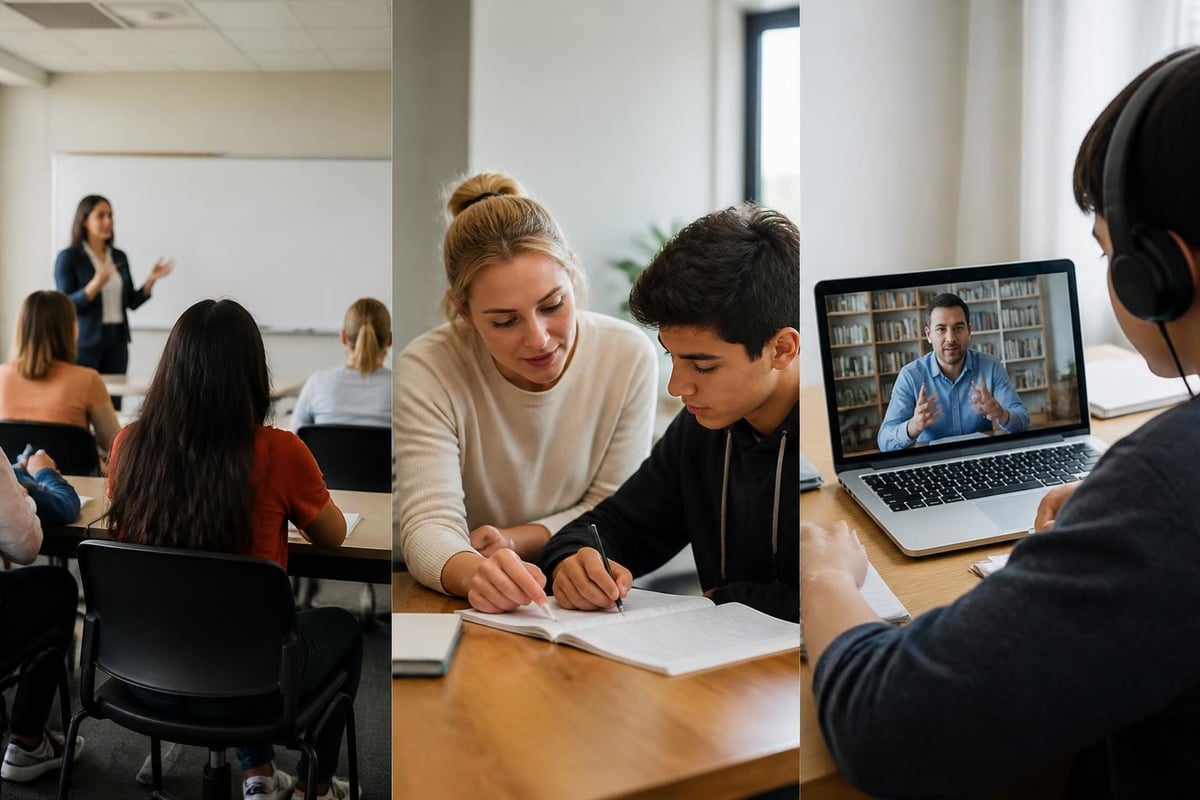
Technical requirements remain minimal-stable internet, webcam, and headphones suffice. The Camões Institute worldwide network provides distance learning opportunities, though accredited private institutions often deliver more personalised attention and flexible scheduling.
Setting Realistic Learning Objectives
Effective portuguese classes begin with clear proficiency targets aligned to internationally recognised frameworks. The Common European Framework of Reference (CEFR) defines six levels from A1 (beginner) through C2 (mastery), providing benchmarks for course selection and progress measurement.
A1-A2: Foundation Building
Beginner portuguese classes establish basic communication abilities:
- Greeting and introducing yourself
- Ordering food and requesting directions
- Shopping and handling simple transactions
- Describing family and daily routines
- Asking and answering basic questions
Students typically require 80-120 hours of instruction to complete A1, with another 100-150 hours reaching A2. These levels suit casual tourists and those beginning Portuguese study with no prior Romance language experience.
B1-B2: Intermediate Competence
Intermediate learners transition from scripted exchanges to spontaneous conversation. B1 competence allows you to handle most travel situations independently, understand workplace instructions, and express opinions on familiar topics. B2 proficiency enables professional Portuguese use in meetings, presentations, and written correspondence.
The NCSSFL-ACTFL Can-Do Statements provide practical benchmarks that teachers incorporate into lesson planning, helping you track tangible progress rather than abstract grammar mastery.
C1-C2: Advanced Fluency
Advanced portuguese classes refine nuanced expression, idiomatic usage, and cultural sophistication. C1 speakers navigate complex texts, appreciate literary subtlety, and handle professional Portuguese across diverse contexts. C2 represents near-native competence with effortless comprehension and sophisticated expression.
Few learners require C2 proficiency unless pursuing academic research, literary translation, or diplomatic careers. Most professional and personal objectives are fully served by B2-C1 competence.
Curriculum Components and Teaching Methodologies
Quality portuguese classes balance four core competencies: speaking, listening, reading, and writing. Modern communicative approaches prioritise practical usage over rote grammar memorisation, though structured instruction in verb conjugations and syntax remains essential.
Grammar Foundations
Portuguese verb systems present the steepest learning curve for English speakers. Six regular tenses multiply across three conjugation patterns, whilst irregular verbs demand individual memorisation. Subjunctive mood usage differs substantially from Spanish, requiring dedicated practice.
Effective courses introduce grammatical concepts progressively, allowing consolidation before adding complexity. Expect substantial attention to:
- Present, preterite, and imperfect indicative
- Future and conditional formations
- Present and imperfect subjunctive
- Personal infinitive (unique to Portuguese)
- Pronominal verb placement
Conversational Practice
Structured dialogue practice distinguishes effective portuguese classes from passive learning. Role-playing scenarios simulate real-world situations-restaurant reservations, medical appointments, job interviews, client negotiations. Immediate correction prevents fossilised errors whilst building confidence through successful communication.
Many schools incorporate native speaker conversation partners once students reach A2-B1 levels, providing authentic interaction that accelerates listening comprehension and cultural awareness.
Cultural Integration
Language exists within cultural contexts that shape meaning beyond literal translation. Portuguese classes that incorporate cultural education explore:
- Regional variations in formality and address
- Business etiquette across Lusophone markets
- Historical influences on contemporary usage
- Literary and musical traditions
- Social customs and conversational norms
The IILP teacher portal offers extensive cultural resources that qualified instructors integrate into lesson plans, enriching linguistic instruction with contextual understanding.
Certification and Proficiency Assessment
Formal certification validates your Portuguese abilities for immigration, employment, and academic purposes. Different examining bodies serve European and Brazilian variants, each offering standardised testing at multiple CEFR levels.
European Portuguese Examinations
CAPLE (Centro de Avaliação e Certificação de Português Língua Estrangeira) administers internationally recognised exams through the University of Lisbon. Five examination levels span A2 through C2:
| Exam Level | CEFR | Typical Preparation |
|---|---|---|
| CIPLE | A2 | 150-200 hours |
| DEPLE | B1 | 300-400 hours |
| DIPLE | B2 | 500-600 hours |
| DAPLE | C1 | 700-800 hours |
| DUPLE | C2 | 900+ hours |
Portuguese citizenship and permanent residency applications typically require B1 certification, whilst university admission demands B2-C1 depending on programme requirements. Preparation courses specifically targeting exam formats significantly improve pass rates through familiarisation with question types, timing strategies, and assessment criteria.
Brazilian Portuguese Certification
CELPE-Bras (Certificado de Proficiência em Língua Portuguesa para Estrangeiros) serves as Brazil's official proficiency exam, administered by the Brazilian Ministry of Education. Unlike CAPLE's multiple levels, CELPE-Bras issues single certificates marked as intermediate, advanced, or superior proficiency.
Brazilian universities and professional licensing bodies recognise CELPE-Bras certification, whilst many international institutions accept it as Portuguese language proof for admission and employment purposes.

Accreditation and Quality Indicators
Not all portuguese classes deliver equivalent value. Accreditation, instructor qualifications, and institutional track records separate effective programmes from inadequate offerings. When evaluating language schools, examine these quality indicators carefully.
Official Recognition
Accredited institutions maintain standards verified by educational authorities and professional bodies. Registration with departments of education, university partnerships, and examination centre status demonstrate compliance with curricular standards and assessment integrity. Mi Casa of Languages holds unique accreditation as the only Latin language school registered with South Africa's Department of Education, ensuring alignment with recognised educational frameworks.
Instructor Credentials
Qualified Portuguese teachers possess more than native fluency. Look for instructors holding:
- University degrees in Portuguese language or linguistics
- Teaching certifications specific to Portuguese as a foreign language
- Demonstrated experience across proficiency levels
- Ongoing professional development participation
The VOC orthographic database serves as the authoritative reference for spelling and usage questions, which qualified teachers consult when addressing student queries about variant differences.
Student Outcomes
Success rates, testimonial patterns, and alumni achievements indicate programme effectiveness. Schools publishing transparent outcome data demonstrate confidence in their methodologies. 100% pass rates on certification exams suggest thorough preparation, whilst graduate career advancement and successful relocations validate practical competence development.
Request trial lessons or consultation sessions before committing to extended programmes. This allows assessment of teaching style, pace, and personality fit-factors that significantly influence learning motivation and persistence.
Practical Considerations for Course Selection
Beyond pedagogical quality, logistical factors determine whether portuguese classes fit your lifestyle and budget constraints. Thoughtful evaluation of these practical elements prevents frustration and programme abandonment.
Scheduling Flexibility
Adult learners juggle professional commitments, family responsibilities, and personal obligations. Courses offering multiple class times, makeup lesson policies, and schedule adjustment options accommodate inevitable conflicts. Evening and weekend availability proves essential for working professionals, whilst daytime sessions suit retirees and students.
Online formats provide maximum flexibility, though some learners struggle with self-discipline in remote settings. Hybrid models combining structured online lessons with optional in-person conversation groups balance convenience with accountability.
Financial Investment
Portuguese classes represent significant financial commitments, with costs varying substantially by format, location, and provider. Typical pricing ranges include:
- Group classes: £15-35 per hour
- Private tutoring: £35-75 per hour
- Intensive programmes: £800-2,500 per week
- Semester courses: £1,200-3,500 for 60-80 hours
Many schools offer package discounts for prepaid lesson blocks, though verify refund policies before committing to large upfront payments. Some institutions provide payment plans that distribute costs across programme duration, improving accessibility for budget-conscious learners.
Spanish & Portuguese online Language courses deliver affordable, accessible instruction that accommodates diverse budgets whilst maintaining accredited quality standards. The flexibility to work around student schedules-rather than forcing learners into fixed timetables-demonstrates genuine commitment to accessibility beyond mere marketing rhetoric.

Geographic Accessibility
Physical school locations matter for in-person instruction. Commute duration impacts attendance consistency, with lengthy travel increasing dropout likelihood. Urban centres typically offer more provider choices, whilst rural learners may find online instruction their only viable option.
International students can access portuguese classes from anywhere globally, with qualified instructors delivering live sessions across time zones. This geographic independence particularly benefits expatriates, remote workers, and those preparing for relocation whilst still residing in their home countries.
Supplementary Resources and Practice Opportunities
Classroom instruction forms your learning foundation, but supplementary practice accelerates progress substantially. Effective portuguese classes incorporate or recommend complementary resources that extend learning beyond scheduled sessions.
Authentic Media Consumption
Portuguese-language films, podcasts, news broadcasts, and literature provide immersive exposure that develops listening comprehension and vocabulary breadth. Begin with subtitled content at your current level, gradually reducing subtitle dependency as comprehension improves.
Brazilian Portuguese learners enjoy vast media libraries including telenovelas, music streaming, and YouTube channels. European Portuguese content proves sparser but includes RTP programmes, Pessoa's poetry, and Saramago's novels for advanced readers.
Language Exchange Partnerships
Conversation partners offer reciprocal practice, with Portuguese speakers seeking English fluency exchanging time with you. Applications like Tandem and HelloTalk facilitate structured exchanges, though some learners prefer informal arrangements through community groups or university programmes.
Digital Tools and Applications
Whilst insufficient as standalone learning methods, applications complement formal portuguese classes effectively. Vocabulary builders like Anki employ spaced repetition for efficient memorisation. Grammar references such as Conjuu provide quick conjugation lookups. Pronunciation tools offer speech recognition feedback between instructor sessions.
Avoid substituting applications for structured instruction. They lack the personalisation, cultural context, and corrective feedback that qualified teachers provide. Use them as homework supplements, not primary learning vehicles.
Common Challenges and Solutions
Every Portuguese learner encounters predictable obstacles. Anticipating these difficulties and employing targeted strategies minimises frustration and maintains motivation through challenging progression phases.
Pronunciation Difficulties
Portuguese phonology presents particular challenges for English speakers. Nasal vowels, the distinctive "ão" diphthong, and vowel reduction in unstressed syllables require dedicated practice. Many learners struggle with:
- Distinguishing between open and closed vowel sounds
- Producing nasal resonance correctly
- Managing consonant clusters
- Mastering the "lh" and "nh" sounds
- Varying intonation patterns appropriately
Regular feedback from qualified instructors prevents pronunciation fossilisation. Recording yourself and comparing against native models helps identify specific areas requiring attention.
Verb Conjugation Complexity
Portuguese verbs intimidate many beginners, with extensive irregular patterns and subjunctive applications foreign to English grammar. Systematic approaches work better than memorisation attempts:
- Master present indicative before adding complexity
- Group irregular verbs by pattern similarities
- Practice high-frequency verbs until automatic
- Use conjugation drills daily in short sessions
- Apply new forms immediately in speaking practice
Portuguese classes that introduce conjugations progressively whilst ensuring consolidation prevent overwhelming confusion that derails many self-taught learners.
Maintaining Motivation
Language acquisition requires sustained effort over months or years. Motivation inevitably fluctuates, particularly during intermediate plateaus where progress feels slower despite continued effort. Setting micro-goals maintains momentum: order successfully in Portuguese at a restaurant, understand a news article, complete a phone conversation without English.
Join Portuguese-speaking communities, attend cultural events, plan trips to Lusophone destinations, or find professional applications for emerging skills. External accountability through group classes or scheduled private lessons prevents abandonment during motivation dips.
Long-Term Maintenance and Continued Development
Reaching your target proficiency represents a milestone, not a destination. Language skills atrophy without regular use. Post-course maintenance strategies preserve your investment whilst continuing skill development.
Active Usage Opportunities
Seek regular Portuguese communication through professional contexts, volunteer translation services, online discussion forums, or expatriate communities. Weekly conversation practice prevents regression far more effectively than periodic review sessions.
Professional certifications require renewal or retesting after several years, incentivising ongoing engagement. Some learners continue advanced portuguese classes focusing on specialised vocabulary (legal, medical, technical) or literary analysis.
Cultural Immersion Experiences
Short-term immersion programmes in Portugal, Brazil, or African Portuguese-speaking nations provide intensive practice whilst enriching cultural understanding. Even two-week visits substantially boost confidence and colloquial competence when combined with deliberate practice commitments rather than tourist passivity.
Teaching Others
Tutoring beginners consolidates your own knowledge through explanation and error correction. Volunteer literacy programmes, conversation partner arrangements, or informal instruction for colleagues reinforce grammatical understanding whilst building community connections.
Selecting the right portuguese classes transforms abstract linguistic interest into practical communication competence that enhances professional prospects, enriches travel experiences, and builds meaningful cross-cultural relationships. Whether you're pursuing European Portuguese for relocation, Brazilian Portuguese for business expansion, or simply exploring linguistic curiosity, accredited instruction from qualified teachers delivers measurably faster progress than self-study alternatives. Mi Casa of Languages combines flexible scheduling, personalised attention, and proven methodologies to support learners across South Africa and worldwide, ensuring you develop confident Portuguese fluency aligned to your specific goals and timeline.





Recent Comments