



Language proficiency testing has become essential for anyone seeking to demonstrate their Portuguese skills formally, whether for immigration, university admission, career advancement, or personal validation. A portuguese language test serves as an internationally recognised measure of your ability to communicate effectively in Portuguese, opening doors to opportunities across Portugal, Brazil, Angola, Mozambique, and other Lusophone nations. Understanding which test suits your goals, how to prepare effectively, and what examiners expect can transform a daunting assessment into a manageable milestone on your language-learning journey.
Understanding Portuguese Language Proficiency Frameworks
The Common European Framework of Reference for Languages (CEFR) provides the foundation for most Portuguese language testing systems. This six-level framework ranges from A1 (beginner) through C2 (mastery), creating a standardised vocabulary for discussing language ability across Europe and beyond.
Portuguese language tests typically align with these CEFR levels, allowing employers, universities, and immigration authorities to interpret results consistently. Level A1 indicates basic phrases and simple interactions, whilst A2 demonstrates elementary proficiency for everyday situations. B1 marks independent user status with conversational ability, and B2 reflects upper-intermediate competence suitable for many professional contexts.
The advanced levels carry particular weight. C1 demonstrates effective operational proficiency for complex academic and professional environments, whilst C2 represents near-native mastery. Most portuguese language test systems offer separate certificates for each level, allowing candidates to target assessments appropriate to their current abilities and future requirements.
CAPLE Certification System
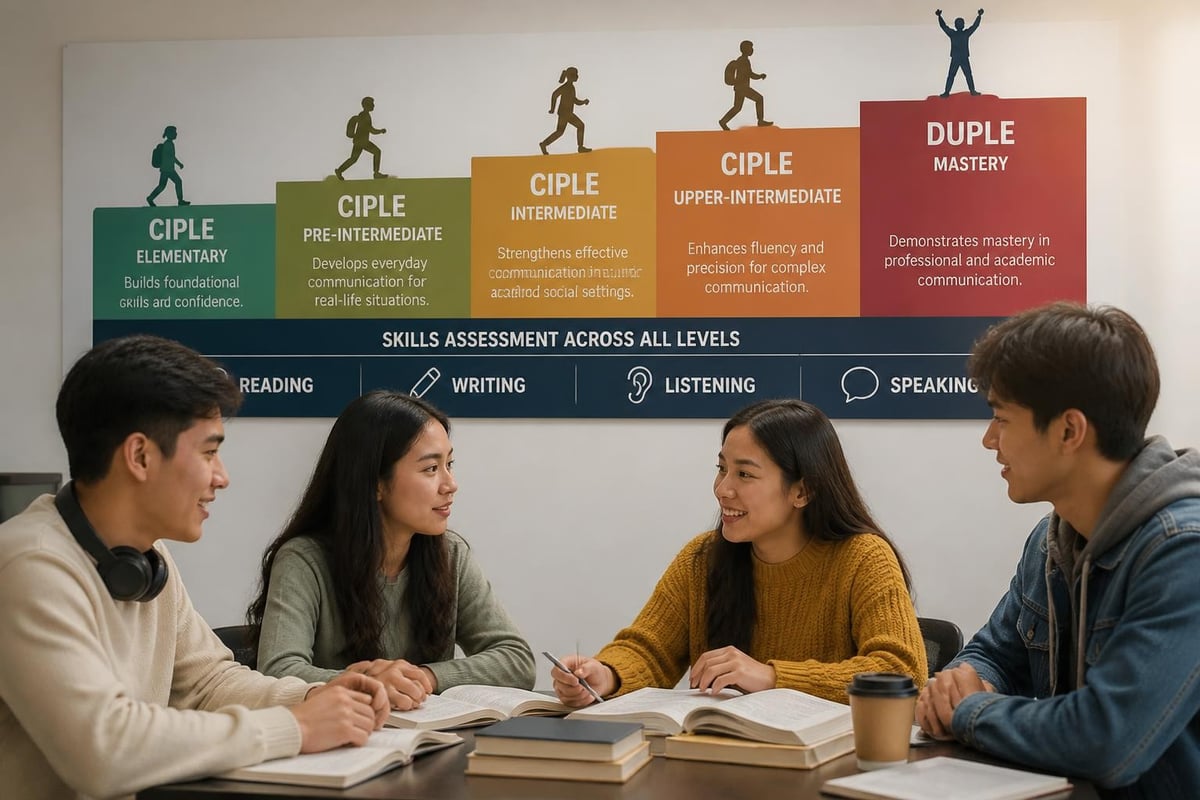
The CAPLE (Centro de Avaliação e Certificação de Português Língua Estrangeira) system represents the gold standard for European Portuguese assessment. Administered by the University of Lisbon, CAPLE offers six distinct examinations corresponding to CEFR levels.
| CAPLE Certificate | CEFR Level | Typical Candidates |
|---|---|---|
| CIPLE | A2 | Beginners with basic skills |
| DEPLE | B1 | Intermediate learners |
| DIPLE | B2 | Upper-intermediate students |
| DAPLE | C1 | Advanced professionals |
| DUPLE | C2 | Near-native speakers |
| Acesso | A2 | Citizenship applicants |
These certificates carry official recognition from Portuguese government ministries, universities, and professional bodies. A portuguese language test through CAPLE typically includes reading comprehension, writing production, listening comprehension, and oral interaction components. Each section receives separate scoring, with candidates needing to achieve minimum thresholds across all skills to pass.
Portuguese Language Tests for Specific Purposes
Different life circumstances demand different approaches to Portuguese proficiency assessment. Selecting the appropriate portuguese language test ensures your efforts align with your objectives and the requirements of institutions or authorities evaluating your skills.
Immigration and Citizenship Requirements
Portugal's nationality law requires applicants to demonstrate basic Portuguese knowledge. The IAVE (Instituto de Avaliação Educativa) administers the Prova de Acesso à Nacionalidade (PaN), a citizenship-focused assessment calibrated to A2 level. This portuguese language test emphasises practical communication skills needed for daily life in Portugal.
Key features of the PaN include:
- Simplified registration through municipal offices
- Audio-visual stimuli reflecting real Portuguese contexts
- Multiple-choice and short-answer formats
- Lower cost compared to comprehensive CAPLE examinations
- Results valid specifically for citizenship applications
Golden Visa holders and other residency applicants may choose between the PaN or CIPLE certificates. Both demonstrate elementary proficiency, though CIPLE offers broader international recognition for those considering further education or professional registration.
Academic Assessment Requirements
Portuguese universities increasingly require international students to verify language proficiency before admission. Each institution sets its own thresholds, but B2 level typically suffices for undergraduate programmes, whilst postgraduate study often demands C1 certification.
A portuguese language test for academic purposes must assess sophisticated skills: understanding lectures, participating in seminars, reading academic texts, and producing formal written work. CAPLE's DIPLE (B2) and DAPLE (C1) certificates serve these requirements well, with exam content incorporating academic vocabulary and formal register.
Professional Certification Contexts
Regulated professions in Portugal-including medicine, law, engineering, and teaching-require practitioners to demonstrate Portuguese competence. Professional regulatory bodies often specify minimum portuguese language test results alongside technical qualifications.
Common professional requirements:
- Healthcare professionals: B2 minimum, C1 preferred
- Legal practitioners: C1 mandatory for court appearances
- Teachers: C2 for Portuguese language instruction, C1 for other subjects
- Engineers: B2 sufficient for most registrations
Many professionals pursue certification whilst already working in Portuguese environments, using workplace immersion to supplement formal study. Mi Casa of Languages supports learners worldwide, offering flexible schedules that accommodate working professionals preparing for certification examinations.
Test Components and Assessment Methodology
Every reputable portuguese language test evaluates four core competencies: reading, writing, listening, and speaking. Understanding how examiners assess each skill helps candidates prepare strategically and demonstrate their abilities effectively.
Reading Comprehension Assessment
Reading sections present authentic texts-newspaper articles, advertisements, literary excerpts, formal correspondence-with comprehension questions testing literal understanding, inference, and critical analysis. A2-level tasks might ask candidates to extract specific information from a train timetable, whilst C1 assessments require analysing argumentative structure in opinion pieces.
Time management proves crucial. Most portuguese language test reading sections allocate approximately one minute per question, forcing candidates to balance careful reading with efficient pace. Practising with timed materials builds the stamina and strategic skimming skills needed for success.
Writing Production Standards
Writing tasks vary by proficiency level but always require candidates to produce coherent, appropriate Portuguese text. Elementary examinations might request a simple email or postcard, whilst advanced tests demand formal reports, opinion essays, or analytical reviews.
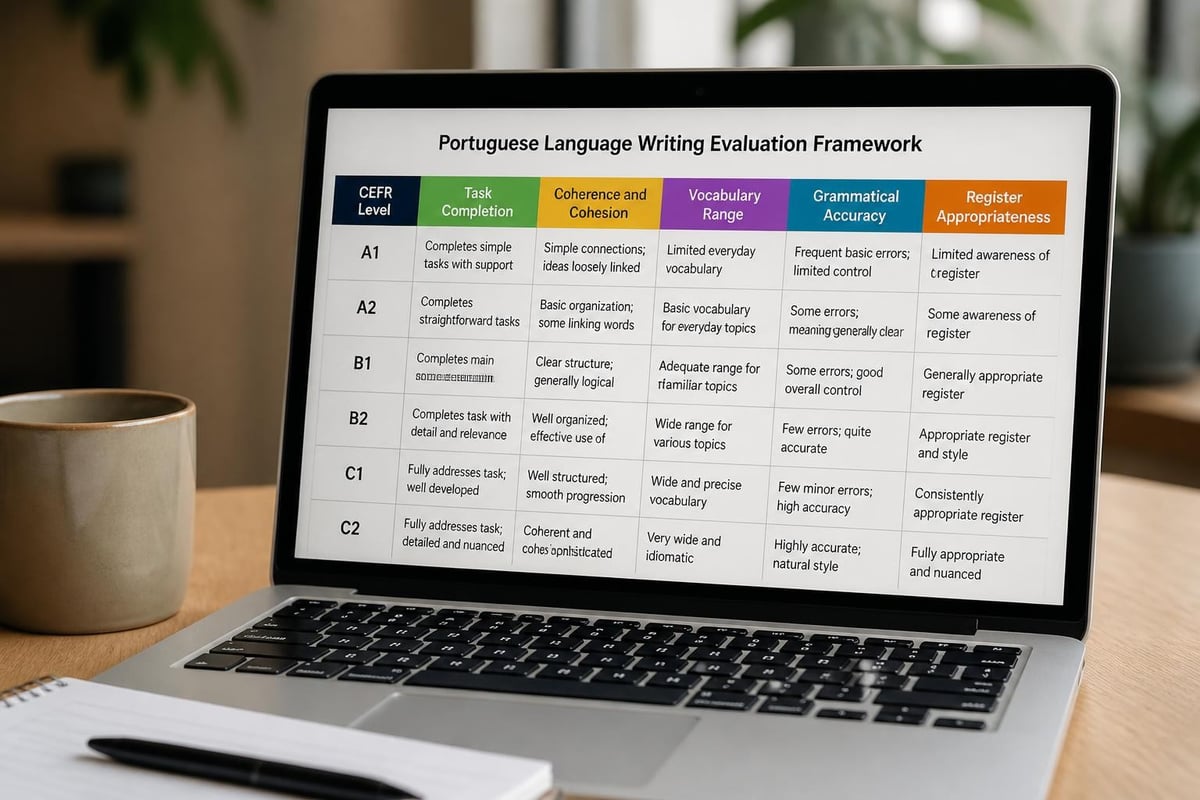
According to research on Portuguese proficiency assessment, scoring rubrics typically evaluate:
- Task completion: addressing all required points
- Coherence and cohesion: logical organisation and linking
- Lexical range and accuracy: vocabulary breadth and precision
- Grammatical control: syntax complexity and error frequency
- Register appropriateness: formal/informal style matching context
Candidates should allocate time for planning, drafting, and reviewing. Even advanced speakers make careless errors under exam pressure; systematic proofreading catches mistakes that would otherwise cost marks.
Listening Comprehension Challenges
Listening sections use audio recordings of conversations, announcements, lectures, or broadcasts. The Standards for Educational and Psychological Testing emphasise the importance of authentic speech rates and natural acoustic conditions in valid assessment.
A portuguese language test listening component typically plays each recording twice, with questions appearing before and after. Candidates must extract specific details, identify main ideas, understand speaker attitudes, and follow complex argumentation depending on proficiency level.
| Proficiency Level | Listening Task Examples |
|---|---|
| A2 | Understand simple directions, phone messages |
| B1 | Follow straightforward news reports, informal conversations |
| B2 | Comprehend extended discussions, documentary segments |
| C1 | Extract subtle implications from debates, academic lectures |
Preparation strategies include:
- Regular exposure to Portuguese radio, podcasts, and television
- Practising note-taking whilst listening
- Building familiarity with regional accents and speech varieties
- Developing prediction skills based on context clues
Oral Interaction and Production
Speaking assessments present the greatest anxiety for many candidates yet follow predictable formats. Paired or individual interviews with trained examiners typically involve self-introduction, role-play scenarios, photograph description, and discussion of abstract topics.
Examiners evaluate pronunciation, grammatical accuracy, vocabulary range, fluency, and interactive communication skills. Recent advances in automated Portuguese proficiency evaluation explore computer-assisted scoring, though human examiners remain standard for high-stakes certification.
Successful oral performance requires:
- Confidence over perfection: communicate despite minor errors
- Strategic pausing: gather thoughts rather than filling silence with uncertainty
- Clarification requests: ask for repetition when needed
- Extended responses: elaborate beyond minimal answers
- Appropriate register: match formality to context
Those preparing for a portuguese language test benefit enormously from conversation practice with native speakers or qualified instructors who can provide targeted feedback on pronunciation patterns and discourse strategies.
Preparation Approaches and Study Resources
Strategic preparation transforms language knowledge into examination success. Whilst general Portuguese study builds foundational skills, test-specific preparation familiarises candidates with formats, timing constraints, and examiner expectations.
Structured Course Preparation
Formal instruction provides systematic coverage of exam content alongside expert guidance on test strategy. Spanish & Portuguese online language courses offer comprehensive preparation for Portuguese proficiency testing, combining grammatical instruction, vocabulary development, and extensive practice with authentic assessment materials. These courses suit travellers, professionals, entrepreneurs, students, retirees, and families building practical skills for confident communication and cultural connection.

Accredited programmes ensure curriculum alignment with official examination standards. Mi Casa of Languages maintains a 100% success rate through tailored instruction that addresses individual learning needs whilst covering all required competencies systematically.
Self-Study Materials and Practice Tests
Independent learners supplement coursework or prepare autonomously using official practice materials, textbook series designed for CAPLE preparation, and authentic Portuguese media. The CAPLE website provides specimen papers demonstrating question formats and difficulty levels for each certification tier.
Effective self-study incorporates:
- Diagnostic testing: identifying strengths and weaknesses early
- Focused skill development: addressing specific deficits
- Timed practice: building exam stamina and pace
- Performance review: analysing errors to prevent repetition
- Progressive challenge: gradually increasing difficulty
Regular assessment using practice tests under exam conditions builds confidence and reveals remaining preparation needs. Many candidates schedule their portuguese language test only after consistently achieving passing scores on multiple full-length practice examinations.
Language Immersion Strategies
Immersive exposure accelerates acquisition and develops the automatic processing required for timed assessments. Whilst residing in Portugal or Brazil offers maximum immersion, learners anywhere can create rich Portuguese environments through intentional media consumption and interaction.
Immersion techniques include:
- Switching device language settings to Portuguese
- Following Portuguese social media accounts and news sources
- Joining online conversation groups with native speakers
- Watching Portuguese films and series without subtitles
- Reading Portuguese books, beginning with familiar content
Even thirty minutes daily of immersive Portuguese exposure compounds significantly over months of preparation, building the intuitive language sense that distinguishes advanced proficiency from textbook knowledge.
Understanding Test Administration and Logistics
Practical considerations around registration, scheduling, costs, and results can significantly impact the examination experience. Candidates who understand administrative procedures avoid unnecessary stress and ensure compliance with all requirements.
Registration Processes and Documentation
CAPLE examinations run multiple times annually at approved centres worldwide. Registration typically opens two to three months before each session, with candidates submitting applications through testing centres or online portals. Required documentation usually includes:
- Valid identity document (passport or national ID)
- Completed registration form with personal details
- Examination fee payment confirmation
- Passport-style photograph meeting specifications
Early registration secures preferred dates and locations, particularly important for candidates with scheduling constraints or those travelling to testing centres. Some locations fill quickly during peak seasons when citizenship or university applications cluster.
Fee Structures and Investment
A portuguese language test represents a significant investment, with CAPLE certification fees ranging from approximately €85 for CIPLE to €135 for DUPLE (2026 rates). These costs cover examination development, administration, marking by qualified assessors, and certificate production.
Additional expenses may include:
- Preparation course tuition
- Practice materials and textbooks
- Travel and accommodation for distant testing centres
- Potential re-examination fees if initial attempts prove unsuccessful
Whilst costs accumulate, Portuguese certification provides lasting value. Unlike informal assessments, CAPLE certificates carry permanent validity without expiration dates, serving as lifelong proof of achievement.
Results Processing and Certificate Issuance
Examination results typically become available six to eight weeks after test administration. Candidates receive detailed score reports showing performance across all assessed competencies, even when overall results fall short of passing thresholds.
Successful candidates receive official certificates bearing the University of Lisbon seal and CAPLE signatures. These documents require careful preservation, as replacement certificates involve additional fees and administrative processes. Many institutions accept certified copies rather than originals, allowing candidates to maintain secure archives whilst distributing verification documentation as needed.
Special Considerations for European vs Brazilian Portuguese
Portuguese exists in multiple varieties, with European and Brazilian Portuguese representing the two major standard forms. Most international portuguese language test systems assess European Portuguese, though Brazilian Portuguese certification options exist for those focused on Brazilian contexts.
Linguistic Differences Affecting Assessment
Phonology, vocabulary, syntax, and orthography diverge between Portuguese varieties. European Portuguese features vowel reduction, closed syllables, and more conservative pronunciation, whilst Brazilian Portuguese exhibits more open vowels and syllabic clarity. These differences can impact listening comprehension for learners trained primarily in one variety.
Key distinctions include:
- Pronunciation: European Portuguese's reduced vowels vs Brazilian clarity
- Vocabulary: different terms for common items (autocarro vs ônibus)
- Grammar: placement of clitic pronouns varies between varieties
- Formality: different conventions around forms of address
CAPLE examinations use European Portuguese exclusively, challenging candidates whose instruction emphasised Brazilian norms. However, examiners understand variety differences and do not penalise Brazilian vocabulary or pronunciation patterns unless they impede comprehension or violate European Portuguese grammar fundamentally.
Choosing the Appropriate Test Variety
Candidates should align their portuguese language test selection with their ultimate objectives. Those planning Portuguese residence, university study in Portugal, or professional practice within European contexts should pursue European Portuguese certification through CAPLE or equivalent systems.
Conversely, learners focused on Brazil might seek the Certificado de Proficiência em Língua Portuguesa para Estrangeiros (Celpe-Bras), Brazil's official proficiency examination administered by the Brazilian Ministry of Education. This assessment follows different structures and scoring criteria whilst maintaining CEFR alignment for international recognition.

Some learners pursue dual certification, demonstrating versatility across Portuguese varieties. This approach particularly benefits translators, international business professionals, and academics engaging with Lusophone communities globally.
Choosing and preparing for the right portuguese language test represents a significant step towards achieving your personal, academic, or professional goals within the Portuguese-speaking world. Whether you require certification for citizenship, university admission, professional registration, or simply personal validation of your language journey, understanding examination formats, proficiency levels, and preparation strategies positions you for success. Mi Casa of Languages combines accredited instruction, proven methodology, and flexible scheduling to support learners worldwide in achieving Portuguese proficiency and certification goals, maintaining our 100% success rate through tailored programmes designed around your unique needs and availability.





Recent Comments