



Learning Portuguese opens doors to vibrant cultures spanning four continents, from Brazil's bustling cities to Portugal's historic landscapes, and across Lusophone Africa. Whether you're planning to relocate under a Golden Visa programme, advance your international career, or simply connect with Portuguese-speaking loved ones, the quality of instruction you receive shapes your entire learning journey. Choosing a qualified portuguese teacher who understands your goals, adapts to your schedule, and employs proven methodologies can mean the difference between frustrating stagnation and confident fluency. This guide explores what makes an exceptional Portuguese instructor and how to identify the right fit for your unique needs in 2026.
Understanding Portuguese Language Variants
Portuguese exists in multiple official variants, each with distinct pronunciation patterns, vocabulary choices, and grammatical preferences. A skilled portuguese teacher will clarify these differences early in your learning journey.
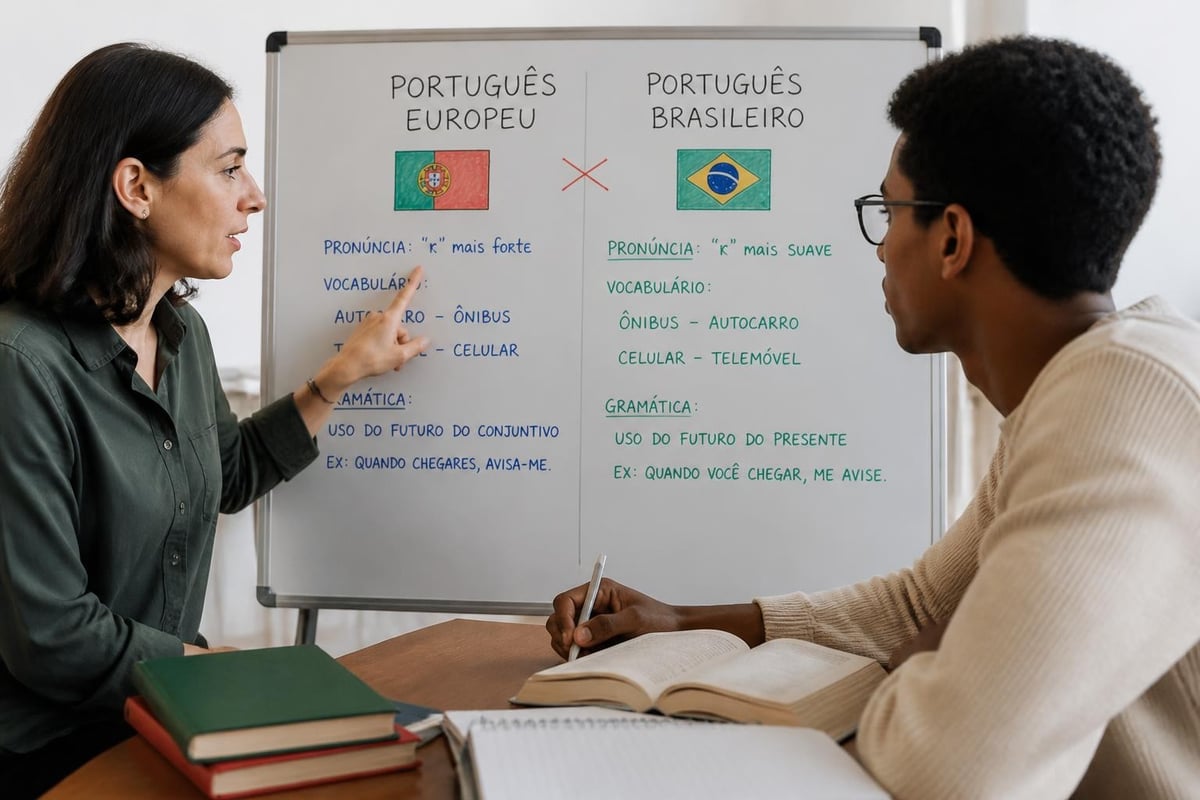
European vs Brazilian Portuguese
European Portuguese (EP) and Brazilian Portuguese (BP) represent the two dominant variants, and your choice depends entirely on your personal or professional goals. European Portuguese maintains closer links to historical pronunciations, features more closed vowel sounds, and places object pronouns differently in sentences. Brazilian Portuguese, spoken by over 215 million people, uses more open vowels, simplified verb conjugations in spoken form, and distinct vocabulary for everyday objects.
Key differences include:
- Pronunciation: EP speakers often drop or soften vowel sounds between consonants, whilst BP preserves clearer vowel articulation
- Vocabulary: "autocarro" (EP) versus "ônibus" (BP) for bus; "comboio" (EP) versus "trem" (BP) for train
- Grammar: Verb placement with pronouns shifts between variants, particularly in informal speech
- Formality levels: BP tends toward more relaxed pronoun usage in daily conversation
Your portuguese teacher should assess which variant aligns with your objectives during your initial consultation. Those planning to settle in Portugal, pursue Portuguese language certification through university exams, or work with Portuguese institutions benefit from EP instruction. Conversely, learners targeting Brazilian markets, cultural engagement, or travel throughout South America gain more value from BP-focused teaching.
African and Asian Portuguese
Portuguese holds official status in Angola, Mozambique, Guinea-Bissau, Cape Verde, São Tomé and Príncipe, Equatorial Guinea, and Timor-Leste. These variants blend Portuguese foundations with indigenous languages, creating unique pronunciation and lexical features. A comprehensive portuguese teacher acknowledges these varieties and can prepare learners for specific regional contexts, particularly those working in development, diplomacy, or international commerce.
| Variant | Speakers (millions) | Distinguishing Features | Primary Use Cases |
|---|---|---|---|
| European Portuguese | 10 | Conservative pronunciation, formal structures | Portugal residence, EU contexts, certification |
| Brazilian Portuguese | 215 | Open vowels, simplified colloquial forms | Brazilian business, South American travel, cultural media |
| African Portuguese | 45+ | Creole influences, regional vocabulary | NGO work, African markets, development sector |
| Asian Portuguese | 1+ | Historical forms, substrate influences | East Timor contexts, historical research |
Essential Qualifications and Credentials
Selecting a portuguese teacher requires examining both formal credentials and practical teaching experience. Professional qualifications signal commitment to pedagogical standards and subject mastery.
Academic Background and Certifications
Look for instructors who hold recognised qualifications in Portuguese language teaching or linguistics. The Camões Institute certifies Portuguese language teachers globally and maintains standards for pedagogical excellence. Teachers may also hold degrees in Portuguese philology, applied linguistics, or modern languages from accredited universities.
Valuable credentials include:
- University degrees in Portuguese, Romance Languages, or Linguistics
- Teaching certifications from the Camões Institute or equivalent bodies
- CELTA, DELTA, or similar language-teaching qualifications adapted to Portuguese
- Specialised training in assessment frameworks (CEFR levels A1 through C2)
- Continuous professional development through ACTFL resources or similar organisations
Accreditation and Recognition
Institutional accreditation provides accountability and quality assurance. Schools registered with educational authorities undergo regular review and maintain transparent standards. When institutions hold university partnerships or governmental recognition, students gain confidence in curriculum quality and assessment integrity. Accredited programmes often align with international frameworks, ensuring your progress translates across borders.
The most reputable Portuguese language schools maintain registration with national education departments and collaborate with universities to validate course content and examination standards. This oversight guarantees that your portuguese teacher follows evidence-based methodologies and prepares you adequately for recognised proficiency assessments.
Teaching Methodologies That Deliver Results
Methodology determines learning efficiency. A qualified portuguese teacher employs diverse approaches tailored to your learning style, goals, and schedule constraints.
Communicative Language Teaching
Modern Portuguese instruction prioritises functional communication over rote memorisation. Communicative approaches immerse learners in realistic scenarios from the first lesson, building practical skills for travel, work, and social interaction. Your portuguese teacher should integrate speaking, listening, reading, and writing within meaningful contexts rather than isolated grammar drills.
Recent research on dynamic grammar teaching in Portuguese as a foreign language demonstrates that contextualised, usage-based approaches accelerate acquisition and improve retention. Rather than front-loading abstract grammatical rules, effective teachers introduce structures through authentic materials, then guide learners to recognise patterns and apply them independently.

Personalised Learning Paths
One-size-fits-all curricula fail to address individual goals. An exceptional portuguese teacher conducts thorough needs analysis before designing your programme, identifying whether you prioritise business Portuguese for negotiations, conversational skills for family connections, or academic language for university studies.
Personalisation elements include:
- Diagnostic assessments establishing current proficiency level
- Goal-setting sessions defining target outcomes and timelines
- Custom materials reflecting your professional field or interests
- Flexible pacing accommodating your learning speed and availability
- Regular progress reviews with adjusted teaching strategies
Whether you're a professional seeking rapid advancement or a retiree learning at a leisurely pace, your instructor should adapt teaching intensity, materials complexity, and homework expectations accordingly. This flexibility proves especially valuable for learners balancing language study with demanding careers or family responsibilities.
Scheduling Flexibility and Accessibility
Practical constraints often derail even the most motivated learners. A portuguese teacher who accommodates your lifestyle enables consistent progress without unsustainable disruption.
Online vs In-Person Instruction
The 2020s have revolutionised language education through digital platforms. Online Portuguese lessons eliminate commute time, expand instructor selection beyond geographical limits, and often reduce costs. High-quality video conferencing, shared digital whiteboards, and cloud-based materials create interactive learning environments rivalling physical classrooms.
| Delivery Mode | Advantages | Ideal For |
|---|---|---|
| Online | Schedule flexibility, location independence, often lower cost, access to specialist teachers globally | Busy professionals, remote learners, those without local Portuguese schools, international students |
| In-person | Face-to-face interaction, fewer technical barriers, easier pronunciation observation | Learners preferring traditional settings, those with reliable local options, complete beginners who benefit from physical presence |
| Hybrid | Combines flexibility with periodic face-to-face sessions | Learners seeking balanced approach, those with variable schedules |
For learners across South Africa or worldwide, Spanish & Portuguese online Language courses deliver expert instruction without geographical constraints, working around your existing commitments whilst maintaining rigorous academic standards.

Asynchronous Resources and Support
Beyond live lessons, the best portuguese teacher provides comprehensive support materials for self-study. Recorded pronunciation guides, grammar reference documents, curated reading lists, and practice exercises extend learning between sessions. Access to email or messaging support for quick questions maintains momentum and prevents small confusions from compounding into major obstacles.
Modern learning management systems allow teachers to track your progress, assign multimedia homework, and provide written feedback asynchronously. This continuous engagement reinforces concepts and maximises the value of each live teaching hour.
Cultural Competence and Real-World Application
Language and culture intertwine inseparably. A truly effective portuguese teacher integrates cultural education throughout the curriculum, preparing you for authentic interactions.
Cultural Context in Language Learning
Portuguese grammatical structures reflect cultural values. The language's formal and informal registers (tu vs você in Brazil; tu vs você vs o senhor/a senhora in Portugal) carry social meaning beyond mere politeness. Understanding when to use each form requires cultural awareness your portuguese teacher should explicitly teach.
Cultural instruction encompasses:
- Social etiquette and conversation norms
- Business protocols for Portuguese-speaking markets
- Regional festivals, traditions, and historical context
- Current affairs and contemporary issues in Lusophone countries
- Food culture, arts, music, and literature as language learning vehicles
This cultural grounding transforms mechanical language knowledge into genuine communicative competence. When your instructor shares insights about Portuguese-speaking societies, language patterns gain meaningful context that aids memory and application.
Practical Language for Specific Purposes
Generic Portuguese instruction serves general learners, but specialised needs demand targeted expertise. A skilled portuguese teacher tailors vocabulary and scenarios to your professional or personal context. Medical professionals require different Portuguese than hospitality workers; Golden Visa applicants need different skills than academics pursuing postgraduate studies.
Specialised Portuguese domains include:
- Business Portuguese: Negotiations, presentations, correspondence, contract terminology
- Medical Portuguese: Patient consultations, symptom descriptions, clinical vocabulary
- Legal Portuguese: Regulatory language, documentation, court interactions
- Tourism and hospitality: Customer service phrases, cultural hosting, regional information
- Academic Portuguese: Research writing, seminar participation, thesis defence skills
Discuss your specific requirements during initial consultations. A versatile portuguese teacher will adapt materials and scenarios to maximise practical relevance, whether you're preparing for Lisbon boardrooms or Rio de Janeiro construction sites.
Assessment and Progress Tracking
Measurable progress sustains motivation. Your portuguese teacher should implement clear assessment frameworks aligned with international standards.
CEFR-Aligned Evaluation
The Common European Framework of Reference (CEFR) provides universal language proficiency benchmarks from A1 (beginner) through C2 (mastery). Professional Portuguese instruction maps learning objectives to these levels, enabling transparent progress tracking and credential recognition globally.
Regular formative assessments (ongoing checks during lessons) and periodic summative evaluations (formal tests at level milestones) help your portuguese teacher identify knowledge gaps and adjust instruction. Transparent rubrics for speaking, writing, listening, and reading ensure you understand exactly what each proficiency level requires.
Preparation for Official Certifications
Many learners require official Portuguese proficiency credentials for university admission, visa applications, or employment verification. Your instructor should prepare you for recognised examinations like CAPLE (European Portuguese) or Celpe-Bras (Brazilian Portuguese), familiarising you with test formats, timing strategies, and scoring criteria.
Cambridge International qualifications serve academic contexts particularly well, whilst CAPLE certifications hold authority for Portuguese government and university purposes. Understanding which certification your situation requires helps your portuguese teacher target preparation effectively.
Cost Considerations and Value
Portuguese tuition represents an investment in human capital. Evaluating cost requires examining value rather than price alone.
Pricing Models and Affordability
Portuguese teachers employ various pricing structures, each with trade-offs. Hourly rates for private tuition typically range from £25 to £75, varying with instructor qualifications, lesson duration, and delivery mode. Package deals offering reduced per-lesson costs incentivise commitment whilst reducing total expenditure.
Common pricing approaches:
- Pay-per-lesson: Maximum flexibility, higher per-session cost, suitable for irregular schedules
- Package bundles: Discounted rates for 10, 20, or 50 lesson commitments, better value for serious learners
- Subscription models: Monthly fees for unlimited access to classes and materials, predictable budgeting
- Group classes: Shared costs reduce individual fees, less personalisation but peer interaction benefits
Affordable doesn't mean cheap. The least expensive portuguese teacher may lack qualifications, provide inconsistent scheduling, or use outdated materials that slow your progress. Calculate cost-per-competency-gained rather than cost-per-hour to assess true value.
Return on Investment
Portuguese proficiency generates tangible returns. Professionals commanding Portuguese alongside English access emerging markets across Latin America, Europe, and Africa. The language opens employment opportunities in international organisations, multinational corporations, translation services, and education sectors.
For those pursuing Portuguese or Brazilian residency, language competence streamlines integration, accelerates citizenship eligibility, and enhances quality of life. Golden Visa families gain smoother transitions when adults achieve conversational Portuguese before relocation. Students accessing Portuguese universities through language prerequisites unlock world-class education at European tuition rates.
Finding Your Ideal Portuguese Teacher
The search process requires research, trial sessions, and honest self-assessment. Don't settle for the first instructor you encounter.
Trial Lessons and Compatibility
Most professional Portuguese teachers offer introductory sessions at reduced rates or complimentary. Use these meetings to assess teaching style, personality fit, and pedagogical approach. Effective learning requires rapport-you'll spend hours conversing with this person, so personal compatibility matters alongside credentials.
Evaluate during trial sessions:
- Communication clarity and patience with beginner questions
- Ability to explain grammatical concepts in accessible language
- Responsiveness to your stated goals and concerns
- Technological competence for online platforms (if applicable)
- Enthusiasm for Portuguese language and culture
- Professionalism in scheduling, materials preparation, and follow-up
Don't hesitate to interview multiple instructors before committing. Your choice profoundly impacts learning outcomes, so invest time in finding the right match.
Questions to Ask Prospective Teachers
Prepare specific questions addressing your priorities. Beyond surface-level qualifications, probe teaching philosophy, experience with learners like you, and practical logistics.
Essential questions include:
- What Portuguese variant do you specialise in teaching, and why?
- What qualifications and teaching certifications do you hold?
- How many years have you taught Portuguese to foreign learners?
- What textbooks or materials do you use, and can you provide samples?
- How do you structure lessons for my proficiency level and goals?
- What homework and practice expectations do you set?
- How do you track progress and provide feedback?
- What is your cancellation and rescheduling policy?
- Do you prepare students for official Portuguese proficiency exams?
- Can you provide references or testimonials from previous students?
A confident, professional portuguese teacher welcomes these questions and provides detailed, transparent answers. Evasiveness or reluctance suggests potential issues.
Long-Term Learning Partnerships
Portuguese acquisition spans months or years depending on target proficiency. Your relationship with your portuguese teacher evolves throughout this journey.
Maintaining Motivation Through Plateaus
All language learners encounter plateaus where progress feels invisible despite consistent effort. An experienced portuguese teacher anticipates these phases and implements strategies to maintain engagement. Fresh materials, adjusted difficulty levels, or temporary focus shifts to different skills can reignite progress.
Regular goal reviews keep learning purposeful. As you achieve milestones, your instructor should help set new targets, whether advancing from B1 to B2 proficiency, mastering complex grammatical structures, or developing presentation skills in Portuguese. This forward momentum prevents stagnation and celebrates achievements.
Transitioning to Advanced Studies
Once you achieve intermediate proficiency, your learning needs shift from basic communication to nuanced expression. Your portuguese teacher should facilitate this transition by introducing authentic materials-news articles, podcasts, literature, academic papers-that challenge comprehension whilst building vocabulary breadth.
Advanced instruction focuses on stylistic refinement, idiomatic fluency, and cultural depth. Lessons might analyse Portuguese poetry, debate contemporary issues, or practice simultaneous interpretation. The best instructors continue growing alongside students, introducing ever-more sophisticated content aligned with evolving interests.
Selecting a qualified portuguese teacher who aligns with your goals, schedule, and learning preferences establishes the foundation for successful language acquisition. When you combine expert instruction with consistent practice and cultural immersion, Portuguese fluency becomes an achievable reality rather than a distant aspiration. Mi Casa of Languages connects learners worldwide with accredited Portuguese instructors who deliver personalised, flexible, and results-driven education backed by university partnerships and Department of Education registration. Begin your Portuguese journey today with teaching expertise proven by our 100% success rate across South Africa and globally.





Recent Comments