



Learning Spanish has never been more accessible, and the flexibility of working with a spanish teacher online has revolutionised how students approach language acquisition. Whether you're preparing for a career move, planning travel through Latin America, or simply enriching your cultural understanding, online instruction offers unprecedented convenience and quality. The digital classroom removes geographical barriers, allowing learners worldwide to access qualified instructors who deliver structured, personalised lessons from anywhere with an internet connection. This transformation in education delivery has created opportunities for millions to master Spanish without the constraints of traditional classroom settings.
Why Choose a Spanish Teacher Online
The benefits of online Spanish instruction extend far beyond simple convenience. Flexibility stands at the forefront, allowing students to schedule lessons around work commitments, family responsibilities, or time zone differences. Professional adults can fit lessons into lunch breaks, whilst parents arrange sessions after school drop-offs, and remote workers can learn from anywhere their travels take them.
Cost-effectiveness represents another compelling advantage. Without the overhead of physical facilities, online programmes often deliver exceptional value. Students save on commuting costs, parking fees, and time lost in transit, whilst schools can offer competitive pricing structures that make quality instruction accessible to broader audiences.
Personalised Attention and Tailored Curricula
Working one-on-one with a spanish teacher online creates opportunities for deeply personalised instruction. Your teacher can:
- Adjust pace based on your learning speed and comprehension
- Focus on vocabulary relevant to your specific industry or interests
- Adapt teaching methods to match your learning style
- Provide immediate feedback on pronunciation and grammar
- Design exercises addressing your particular weak points
This individualised approach accelerates progress compared to group settings where instructors must accommodate multiple proficiency levels simultaneously. According to peer-reviewed research on teaching and learning languages online, synchronous one-on-one instruction allows for more authentic conversational practice and targeted intervention.

What to Look for in a Spanish Teacher Online
Selecting the right instructor requires careful evaluation of several critical factors. Qualifications and accreditation should top your list. Seek teachers with recognised certifications in Spanish language instruction, university degrees in linguistics or education, and ideally, accreditation from established educational bodies or language institutions.
Teaching experience matters tremendously. Enquire about how long they've taught Spanish, whether they've worked with students at your proficiency level, and their familiarity with online teaching platforms. An experienced spanish teacher online understands the unique challenges of digital instruction and employs strategies to maintain engagement without physical presence.
Platform Proficiency and Technical Capability
Your instructor's technical competence directly impacts lesson quality. Effective online teachers should demonstrate:
- Stable internet connectivity ensuring uninterrupted lessons
- Professional audio-visual equipment for clear communication
- Platform expertise navigating video conferencing tools smoothly
- Digital resource integration incorporating multimedia content seamlessly
- Screen-sharing capabilities for real-time document collaboration
The TESOL International Association’s strategies for effective online language teaching emphasise that technical preparation enables instructors to focus on pedagogy rather than troubleshooting during valuable lesson time.
| Qualification Type | Why It Matters | What to Verify |
|---|---|---|
| University Degree | Demonstrates deep language knowledge | Request transcripts or certificates |
| Teaching Certification | Proves pedagogical training | Check accreditation body recognition |
| DELE/CEFR Alignment | Ensures standardised progression | Ask about curriculum framework |
| Continuing Education | Shows commitment to improvement | Enquire about recent training |
How Online Spanish Lessons Work
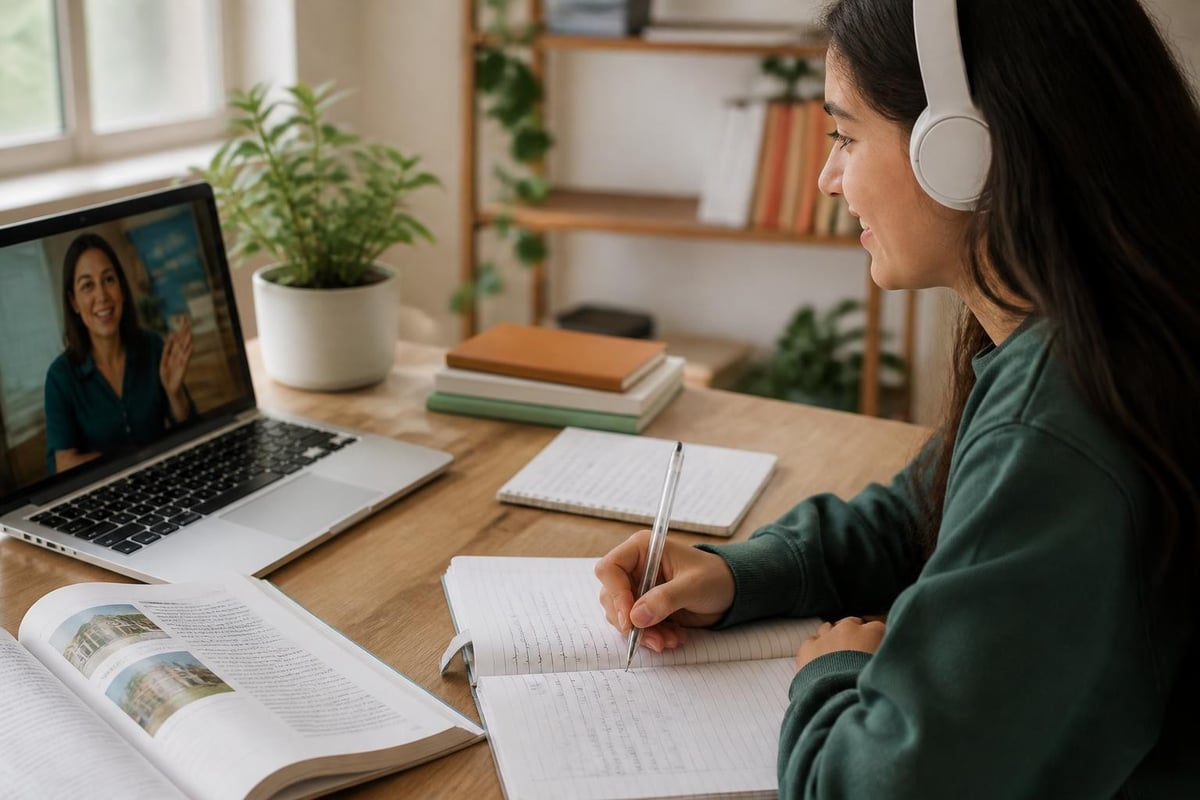
Modern spanish teacher online programmes leverage sophisticated platforms that replicate and often enhance traditional classroom experiences. Video conferencing forms the backbone, with tools like Zoom, Skype, or specialised educational platforms enabling face-to-face interaction. High-quality webcams and microphones ensure you can observe your teacher's mouth movements for pronunciation guidance whilst they hear your attempts clearly.
Interactive whiteboards allow real-time writing and annotation. Your instructor can diagram verb conjugations, highlight corrections in your written work, or illustrate grammatical concepts visually. Many platforms support simultaneous screen sharing, enabling you to follow along in digital textbooks or work through exercises together.
Asynchronous Learning Components
Beyond live lessons, comprehensive online programmes incorporate self-paced elements:
- Pre-recorded video lessons covering fundamental concepts
- Interactive exercises with automated feedback
- Flashcard applications for vocabulary building
- Pronunciation tools analysing your speech patterns
- Written assignments submitted for instructor review
This blended approach, supported by UNESCO’s guidance on distance learning, maximises contact hours whilst allowing students to reinforce concepts independently between sessions.
Pricing Models and Investment Considerations
Spanish teacher online rates vary considerably based on qualification level, lesson format, and programme structure. Individual tutoring typically ranges from £15 to £50 per hour, with native speakers holding advanced degrees commanding premium rates. Package pricing often delivers better value, with schools offering discounted rates when students purchase blocks of 10, 20, or 30 lessons upfront.
Group classes present the most economical option, with per-student costs dropping significantly when spread across multiple learners. However, this format sacrifices the personalised attention that accelerates individual progress.
Calculating True Value
When evaluating pricing, consider the comprehensive package rather than hourly rates alone:
What's included?
- Access to learning management systems
- Supplementary materials and workbooks
- Progress assessments and certificates
- Homework correction and feedback
- Flexibility to reschedule lessons
Hidden costs to watch for:
- Mandatory textbook purchases
- Platform subscription fees
- Examination registration charges
- Cancellation penalties
Students exploring Spanish & Portuguese online Language courses often discover that accredited programmes deliver exceptional value through comprehensive support structures, flexible scheduling, and proven success rates that justify the investment.

Technical Requirements and Learning Environment
Successful online learning requires modest but essential technical infrastructure. Reliable internet connectivity stands paramount-aim for minimum speeds of 10 Mbps download and 5 Mbps upload for smooth video streaming. Hardware requirements include a computer or tablet with functioning camera and microphone, though mobile phones suffice for emergency lesson attendance.
Creating an effective learning environment significantly impacts retention and progress. Designate a quiet space free from interruptions, ensure adequate lighting so your instructor can see your face clearly, and eliminate background noise that might interfere with pronunciation practice. Keep notebooks, pens, and any required materials within arm's reach to avoid lesson disruptions.
Software and Platform Considerations
Most spanish teacher online programmes utilise readily available platforms requiring minimal setup:
| Platform Type | Examples | Best For |
|---|---|---|
| Video Conferencing | Zoom, Google Meet, Skype | Live conversation practice |
| Learning Management | Moodle, Canvas, proprietary systems | Course materials and tracking |
| Language Apps | Duolingo, Babbel, Memrise | Supplementary practice |
| Document Sharing | Google Docs, Dropbox | Homework submission |
Ensure you've tested your chosen platform before your first lesson, checking camera angles, microphone quality, and speaker functionality. Many schools at languagemicasa.com offer technical orientation sessions for new students unfamiliar with online learning tools.
Maximising Progress with Your Online Instructor
Active participation transforms passive lessons into accelerated learning. Preparation sets the foundation-review previous lesson notes before each session, complete assigned homework thoroughly, and prepare questions about concepts you've struggled with independently. This proactive approach signals commitment to your instructor and maximises the value of your contact time.
Consistent scheduling creates language acquisition momentum. Regular sessions, ideally two to three times weekly, embed Spanish into your routine and prevent the knowledge decay that occurs with sporadic study. Communicate your availability clearly and honour scheduled appointments, rescheduling promptly when conflicts arise rather than simply missing sessions.
Communication Strategies for Success
Effective online students cultivate strong instructor relationships through clear communication:
- Express your goals explicitly at programme commencement
- Provide feedback on teaching methods that work or don't
- Request clarification immediately rather than pretending to understand
- Practise between lessons and share your independent study efforts
- Celebrate progress and discuss challenges honestly
Remember that your spanish teacher online cannot observe subtle body language cues as readily as in-person instructors. Verbalise confusion, ask for repetition without embarrassment, and confirm understanding explicitly rather than relying on nodding.
Safeguarding and Professional Standards
When selecting online instruction, particularly for younger learners, safeguarding considerations become paramount. Reputable schools implement rigorous background checks, maintain professional boundaries, and follow established protocols for child protection. The UK government’s guidance on safeguarding and remote education provides frameworks that quality institutions adopt regardless of their jurisdiction.
Data protection represents another critical concern. Online platforms collect substantial personal information, including video recordings, written work, and contact details. Ensure your chosen school complies with relevant data protection regulations, maintains secure systems, and clearly articulates privacy policies. The ICO’s guidance on education technology offers valuable insights into appropriate data handling practices.
Professional Conduct Expectations
Quality spanish teacher online programmes maintain clear professional standards:
- Punctuality with lessons starting and ending at scheduled times
- Preparation with structured lesson plans and relevant materials
- Respect for cultural backgrounds and learning differences
- Confidentiality regarding student progress and personal information
- Transparency about qualifications, pricing, and cancellation policies
Students should feel empowered to raise concerns about inappropriate conduct, technical issues, or pedagogical approaches that aren't working. Established schools welcome feedback and address problems promptly to maintain their reputations.

Certification and Recognised Qualifications
Working towards recognised certifications provides structure and validates your achievement. The Common European Framework of Reference (CEFR) establishes standardised proficiency levels from A1 (beginner) through C2 (mastery), with most professional contexts requiring B2 or higher. Your spanish teacher online should align curriculum with these frameworks, enabling clear progress tracking.
DELE certification, administered by Spain's Cervantes Institute, represents the gold standard in Spanish proficiency credentials. These internationally recognised qualifications enhance CVs, support university applications, and fulfil immigration requirements for Spanish-speaking countries. Quality online programmes prepare students for these examinations systematically.
Accredited institutions registered with educational authorities offer additional credibility. Schools affiliated with universities or officially recognised by education departments demonstrate commitment to quality standards and accountability. This accreditation often enables students to claim tax deductions for education expenses or access funding programmes unavailable through unregistered providers.
Accessibility and Inclusive Learning
Modern online Spanish instruction embraces accessibility principles, removing barriers that previously excluded many potential learners. Web accessibility standards for education guide platforms to accommodate diverse needs, including adjustable text sizes, screen reader compatibility, and closed captioning for hearing-impaired students.
Flexible scheduling particularly benefits those with disabilities, chronic conditions, or irregular work patterns. Lessons conducted from home eliminate mobility challenges, whilst recorded sessions allow students to review content multiple times at their own pace. This flexibility extends to neurodivergent learners who might find traditional classroom environments overwhelming.
Quality spanish teacher online programmes offer multiple modalities:
- Visual learners benefit from written exercises and infographics
- Auditory learners thrive with conversation practice and podcasts
- Kinesthetic learners engage through interactive games and role-play
- Reading/writing learners excel with comprehensive grammar exercises
Discuss your learning preferences openly with instructors, enabling them to adapt teaching methods appropriately. The best teachers recognise that one-size-fits-all approaches rarely optimise outcomes.
The Global Classroom Advantage
Online instruction connects you with native speakers from specific regions, enabling targeted dialect acquisition. Whether you're learning Castilian Spanish for a Madrid posting, Mexican Spanish for border business, or Argentine Spanish for a Buenos Aires relocation, you can engage instructors from precisely those regions. This geographical flexibility proves impossible with local in-person options.
Cultural immersion extends beyond language mechanics. Experienced spanish teacher online professionals share idioms, social customs, current events, and cultural nuances that textbooks cannot convey. This contextual knowledge transforms mechanical vocabulary recitation into authentic communication competence.
The diversity of the global classroom also exposes learners to varied perspectives. In group settings, you might study alongside classmates from five continents, sharing motivations, challenges, and cultural insights that enrich the learning experience beyond pure language acquisition.
Building Long-Term Language Competence
Sustainable Spanish proficiency requires strategies extending beyond scheduled lessons. Daily exposure accelerates acquisition-switch your phone's language settings to Spanish, follow Spanish-language social media accounts, watch films with Spanish subtitles, or listen to podcasts during commutes. These micro-practices compound over time, building intuitive understanding that formal study alone cannot achieve.
Language exchange partnerships complement professional instruction effectively. Many students connect with native Spanish speakers learning English, exchanging conversation practice through video calls. This reciprocal arrangement provides authentic practice whilst helping someone else achieve their goals. Your spanish teacher online can often facilitate these connections or recommend reputable exchange platforms.
Setting incremental goals maintains motivation through the inevitable plateaus. Rather than vague aspirations to "become fluent," establish specific targets: master the subjunctive mood by March, read a Spanish novel by June, or conduct a business presentation in Spanish by year-end. These concrete milestones provide satisfaction as you achieve them and direction for your instructor to structure lessons accordingly.
Choosing Between Solo and Group Online Lessons
The decision between individual and group instruction depends on your learning style, budget, and objectives. Private lessons offer maximum flexibility, personalised pacing, and undivided instructor attention. You'll practise speaking extensively, receive immediate correction, and explore topics aligned with your specific interests or professional needs. This format suits ambitious timelines, specialised vocabulary requirements, or learners uncomfortable making mistakes publicly.
Group classes provide different advantages. The social dimension creates accountability-scheduled classmates expect your attendance, reducing the temptation to skip sessions. You'll observe how others tackle challenges, learn from their mistakes, and practise conversations with multiple partners rather than solely your instructor. Group settings often cost 40-60% less than equivalent private instruction.
| Feature | Private Lessons | Group Classes |
|---|---|---|
| Customisation | Fully tailored curriculum | Standardised progression |
| Speaking Time | Maximum practice | Shared among participants |
| Scheduling | Flexible, negotiated | Fixed timetable |
| Cost per Hour | £25-£50 | £10-£20 |
| Social Learning | Limited peer interaction | Collaborative exercises |
Many successful students combine both formats, using group classes for structured progression and occasional private sessions for targeted skill development or examination preparation.
Working with Time Zones and International Instructors
Global accessibility introduces scheduling considerations that require thoughtful planning. When working with a spanish teacher online based in Spain whilst you're in South Africa, remember the typical two-hour time difference (one hour when European summer time overlaps with South African standard time). Morning lessons for you might represent afternoon sessions for your instructor, affecting energy levels and availability.
Consistent scheduling across time zones requires clear communication. Use shared calendar tools that automatically convert time zones, eliminating confusion about whether "3pm" refers to your location or theirs. Some platforms like languagemicasa.com handle these technicalities administratively, coordinating between students and instructors to prevent missed appointments.
Consider optimal learning times for your cognitive patterns. Research suggests many adults learn complex material most effectively during morning hours when mental energy peaks. However, your schedule might dictate evening lessons-in which case, ensure adequate rest beforehand and avoid booking sessions after mentally exhausting workdays when concentration wanes.
Mastering Spanish through online instruction offers unmatched flexibility, personalised attention, and access to qualified teachers regardless of your location. The right spanish teacher online transforms language learning from an intimidating challenge into an achievable, enjoyable journey. Mi Casa of Languages, as the number one accredited Spanish and Portuguese language school with a 100% success rate, delivers expert instruction tailored to your schedule, whether you're in South Africa or anywhere worldwide. Explore how affordable, accessible courses can help you achieve confident fluency and cultural connection today.





Recent Comments