



Learning a new language opens doors to rich cultural experiences, career opportunities and meaningful connections across continents. For those embarking on beginner Portuguese studies, the journey promises access to over 250 million speakers across Portugal, Brazil, Angola, Mozambique and beyond. Whether you're planning to relocate, expand your business internationally or simply connect with Portuguese-speaking communities, a solid foundation in the language fundamentals will serve you well. This comprehensive guide walks you through everything you need to know about starting your Portuguese learning journey, from pronunciation basics to grammar essentials and practical study strategies that deliver results.
Understanding the Portuguese Language Landscape
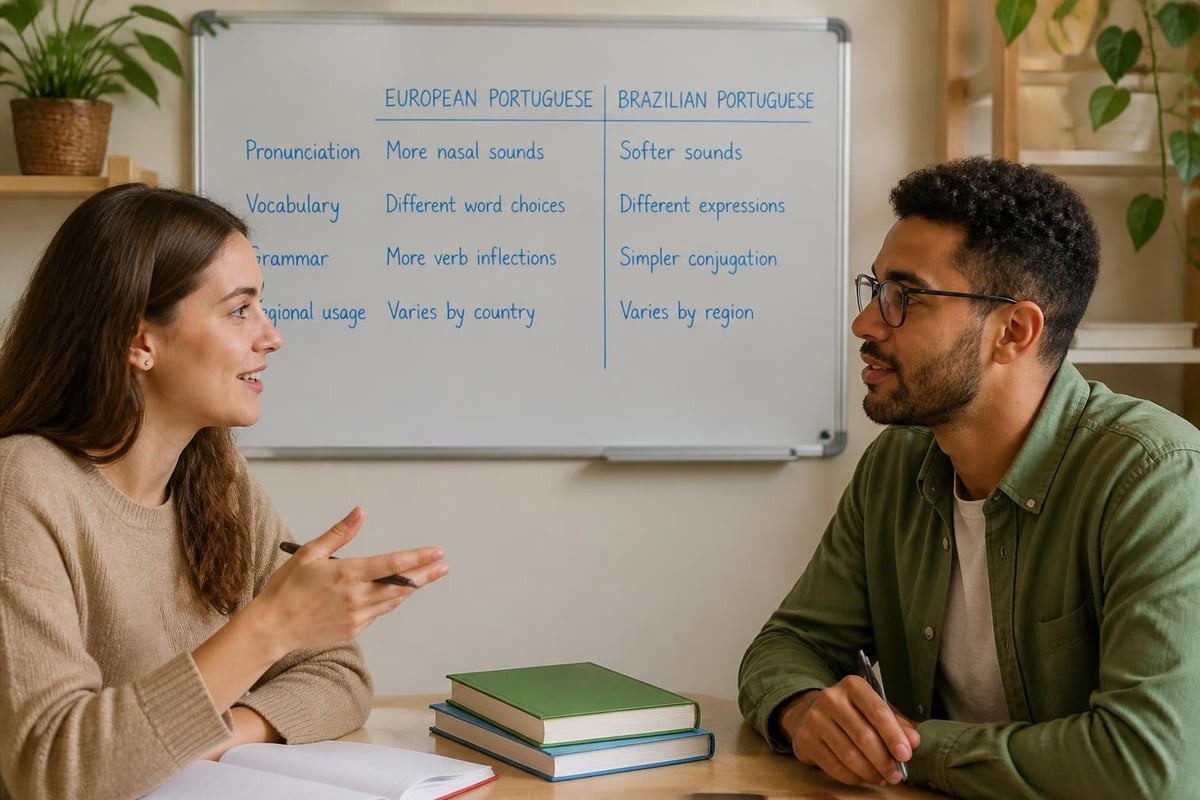
Portuguese stands as the sixth most spoken language globally, yet many learners overlook its strategic value in international business and cultural exchange. The language exists in two primary variants: European Portuguese (EP) and Brazilian Portuguese (BP), each with distinct pronunciation patterns, vocabulary choices and grammatical preferences.
European vs Brazilian Portuguese for Beginners
When starting beginner Portuguese, your first decision involves choosing which variant to prioritise. European Portuguese features more closed vowel sounds and frequent vowel reduction, whilst Brazilian Portuguese tends toward clearer vowel articulation and a more melodic rhythm. The Portuguese writing system and alphabet remain consistent across both variants, using the same 26-letter Latin alphabet with three additional characters: à, ç and õ.
Key differences include:
- Pronunciation: Brazilian Portuguese pronounces 's' at word endings as /s/, whilst European Portuguese shifts to /ʃ/ (like English 'sh')
- Vocabulary: 'train' is comboio in Portugal but trem in Brazil
- Grammar: European Portuguese uses object pronouns differently in continuous tenses
- Formality: European Portuguese maintains stricter formal/informal distinctions
Most beginners find Brazilian Portuguese slightly more accessible due to clearer enunciation, though your choice should ultimately align with your goals. Planning to work in Lisbon? European Portuguese serves you better. Targeting São Paulo business markets? Brazilian Portuguese makes more sense.
Essential Building Blocks for Beginner Portuguese
Mastering beginner Portuguese requires systematic attention to pronunciation, vocabulary acquisition and grammatical foundations. Unlike Spanish, Portuguese phonology presents unique challenges that demand focused practice from day one.
Pronunciation Fundamentals
Portuguese features nasal vowels that don't exist in English, marked by the tilde (~) or followed by 'm' or 'n'. The detailed pronunciation guide comparing European and Brazilian variants helps beginners understand these subtle distinctions. Words like pão (bread), mãe (mother) and não (no) require you to direct air through both your mouth and nose simultaneously.
Critical pronunciation points:
- Master the five nasal vowels: ã, ẽ, ĩ, õ, ũ
- Learn the 'lh' sound (like 'lli' in 'million')
- Practice the rolled 'r' at word beginnings
- Differentiate between open and closed vowels
- Understand consonant palatalization rules
The letter 'r' presents particular challenges. At the beginning of words or doubled (rr), it requires a guttural sound similar to the French 'r' or a strong English 'h'. Between vowels, it softens to a flap similar to the American English 'tt' in 'butter'.
Core Vocabulary Strategies
Building a functional beginner Portuguese vocabulary starts with high-frequency words that appear in everyday conversation. Research shows the 1,000 most common Portuguese words account for approximately 80% of spoken communication.
| Category | Essential Words | Learning Priority |
|---|---|---|
| Greetings | olá, bom dia, boa tarde, tchau | Immediate |
| Numbers | um, dois, três, zero até cem | Week 1-2 |
| Question words | quem, o quê, quando, onde, porquê | Week 2-3 |
| Common verbs | ser, estar, ter, fazer, ir | Week 3-4 |
| Daily nouns | casa, água, comida, tempo | Ongoing |
Focus on cognates-words sharing Latin roots with English-to accelerate vocabulary acquisition. Words like importante (important), diferente (different) and possível (possible) require minimal memorisation effort. However, watch for false friends like embaraçada (embarrassed vs pregnant) that can create confusion.
Grammar Foundations Every Beginner Should Master
Grammar forms the structural backbone of beginner Portuguese competency. Whilst Portuguese shares many features with Spanish, several key differences demand careful attention.
Verb Conjugations and Tenses
Portuguese verbs conjugate according to person, number, tense and mood, creating complexity that initially overwhelms many beginners. Start with present tense conjugations of the three most essential irregular verbs:
Ser (to be – permanent states):
- Eu sou (I am)
- Tu és / Você é (You are)
- Ele/Ela é (He/She is)
- Nós somos (We are)
- Eles/Elas são (They are)
Estar (to be – temporary states):
- Eu estou
- Tu estás / Você está
- Ele/Ela está
- Nós estamos
- Eles/Elas estão
The ser versus estar distinction proves crucial. Use ser for permanent characteristics (Sou britânico – I am British) and estar for temporary conditions (Estou cansado – I am tired). This differs from English, where 'to be' covers both concepts.
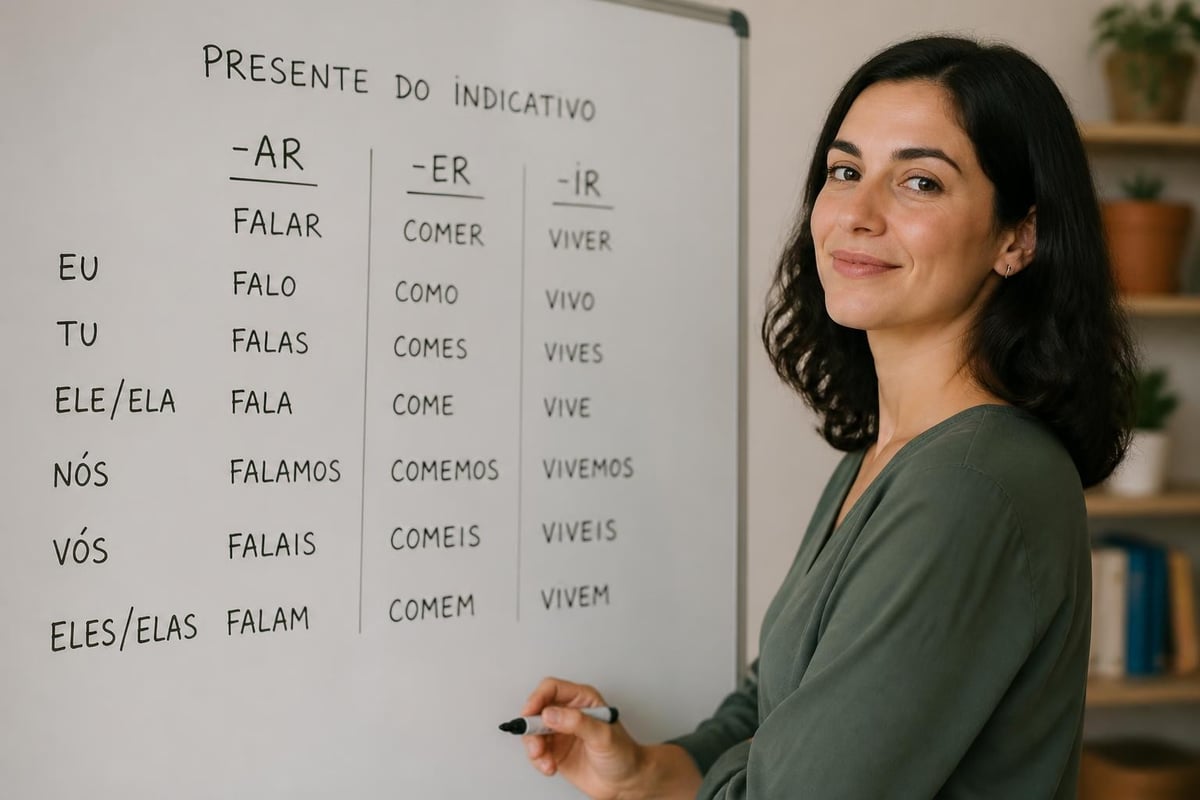
Regular verbs follow three conjugation patterns based on infinitive endings: -ar (falar – to speak), -er (comer – to eat) and -ir (partir – to leave). Master these patterns before progressing to compound tenses.
Gender and Article Agreement
Every Portuguese noun carries grammatical gender-masculine or feminine-requiring corresponding article and adjective agreement. This concept challenges English speakers who lack grammatical gender in their native language.
Generally, nouns ending in -o are masculine (o livro – the book) whilst those ending in -a are feminine (a casa – the house). However, numerous exceptions exist: o dia (day) is masculine despite the -a ending, whilst a mão (hand) is feminine despite ending in -o.
Articles must match noun gender and number:
| Type | Masculine Singular | Masculine Plural | Feminine Singular | Feminine Plural |
|---|---|---|---|---|
| Definite | o | os | a | as |
| Indefinite | um | uns | uma | umas |
Adjectives also agree in gender and number: o carro rápido (the fast car) becomes a moto rápida (the fast motorcycle). Place most adjectives after the noun, though certain common adjectives like bom (good), mau (bad) and grande (big/great) can precede for emphasis or meaning shifts.
Structured Learning Pathways for Beginners
Effective beginner Portuguese study requires structured progression through established proficiency frameworks. The Common European Framework of Reference (CEFR) defines clear benchmarks that guide curriculum development and measure advancement.
The A1 Level Foundation
The ACTFL World-Readiness Standards outline what beginners should accomplish at foundational levels. A1 Portuguese learners develop basic communication abilities in familiar everyday situations.
A1 competencies include:
- Understanding and using familiar everyday expressions
- Introducing yourself and others appropriately
- Asking and answering simple personal questions
- Interacting in a basic way when others speak slowly
- Reading very short, simple texts with familiar vocabulary
Reaching A1 typically requires 80-100 study hours through structured lessons, though individual variation exists based on prior language experience and study intensity. Those with Spanish knowledge often progress faster due to lexical and grammatical similarities.
The Instituto Camões self-learning courses provide CEFR-aligned beginner Portuguese curriculum for independent learners pursuing A1 and A2 objectives through official Portuguese cultural institutions.
Progressing to A2 Elementary Level
A2 represents elementary proficiency where learners handle routine communication requiring direct information exchange. This level builds conversational confidence for basic daily interactions.
At A2, you should manage:
- Describing your background, immediate environment and urgent needs
- Communicating during simple, routine tasks
- Understanding sentences on familiar topics (shopping, employment, local geography)
- Reading short, simple texts containing high-frequency vocabulary
- Writing brief, simple notes and messages
Achieving A2 generally requires an additional 100-120 hours beyond A1, bringing total study time to approximately 200 hours. This milestone enables basic travel independence and simple workplace interactions in Portuguese-speaking environments.
Practical Study Techniques That Work
Beyond formal grammar study, beginner Portuguese success depends on incorporating varied practice methods that develop listening, speaking, reading and writing skills simultaneously.
Immersion Without Travel
Creating Portuguese immersion at home accelerates acquisition through consistent exposure. Change your phone and computer language settings to Portuguese, forcing daily interaction with the language. Listen to Portuguese podcasts during commutes, even if you don't understand everything initially.
Daily immersion activities:
- Watch Brazilian or Portuguese television series with Portuguese subtitles (not English)
- Follow Portuguese social media accounts in areas matching your interests
- Read children's books and graded readers at your level
- Label household objects with Portuguese sticky notes
- Think through your daily routine in Portuguese
The academic reading lists compiled by universities like Oxford provide excellent graded text recommendations for beginners seeking appropriate reading material.
Speaking Practice Strategies
Speaking remains the most challenging skill for many beginner Portuguese learners, particularly without regular conversation partners. Language exchange platforms connect you with native speakers seeking English practice, creating mutually beneficial partnerships.
Record yourself speaking Portuguese daily, even just describing your surroundings or narrating actions. This builds pronunciation confidence whilst creating progress documentation you can review. Shadow native speakers by playing audio and repeating immediately afterwards, matching their rhythm, intonation and pronunciation.

Common Challenges and How to Overcome Them
Every beginner Portuguese learner encounters predictable obstacles. Recognising these challenges early helps you develop targeted strategies to address them effectively.
The Listening Comprehension Gap
Portuguese-especially European Portuguese-features rapid speech with significant vowel reduction and consonant clustering that initially sounds incomprehensible to beginners. Native speakers routinely drop syllables and blend words together in connected speech.
Bridge this gap through:
- Starting with Brazilian Portuguese content if European Portuguese overwhelms you
- Using transcript-supported audio to connect written and spoken forms
- Slowing playback speed to 0.75x whilst building comprehension
- Focusing on one speaker until their pronunciation becomes familiar
- Accepting that comprehension lags production (this is normal)
Listening comprehension develops more slowly than reading or speaking, so frustration at this stage is universal. Consistent exposure gradually trains your ear to segment the continuous sound stream into recognisable words and phrases.
Maintaining Motivation Through Plateaus
Language acquisition follows a non-linear path with rapid initial progress followed by plateaus where improvement feels imperceptible. These flat periods often trigger learner dropout.
| Plateau Stage | Typical Timeline | Breakthrough Strategy |
|---|---|---|
| Basic phrases | Weeks 2-3 | Add structured grammar study |
| Simple conversation | Months 3-4 | Increase native content exposure |
| Intermediate threshold | Months 6-8 | Focus on specific weak skills |
Combat motivation loss by tracking measurable metrics like vocabulary count, conversation duration or content comprehension percentage. Celebrate small wins: successfully ordering food in Portuguese, understanding a song chorus or reading a complete news article.
Building Your Beginner Portuguese Toolkit
Successful language acquisition requires assembling resources that match your learning style, schedule and objectives. The beginner Portuguese landscape offers abundant tools, though quality varies significantly.
Textbooks and Structured Courses
Formal textbooks provide systematic progression through grammar, vocabulary and exercises. Academic publishers produce comprehensive beginner materials with accompanying audio and exercise keys. Examining preview materials helps evaluate whether a textbook's approach suits your preferences.
Structured online courses offer advantages including immediate feedback, progress tracking and multimedia integration. Mi Casa of Languages delivers comprehensive Spanish & Portuguese online language courses designed for learners pursuing confident travel, international career growth and cultural connections. These courses accommodate diverse schedules, making beginner Portuguese accessible regardless of location or time constraints.

Digital Apps and Supplementary Resources
Mobile applications supplement formal study through gamified vocabulary practice and quick grammar drills. Use these tools for review and reinforcement rather than primary instruction, as they typically lack comprehensive explanations of complex grammatical concepts.
Recommended resource categories:
- Spaced repetition flashcard systems for vocabulary retention
- Verb conjugation trainers for drilling tense formations
- News websites with simplified beginner Portuguese articles
- YouTube channels dedicated to Portuguese instruction
- Dictionary apps with audio pronunciation and example sentences
Combine multiple resource types rather than relying exclusively on a single platform. This varied approach addresses different skill areas whilst maintaining engagement through format diversity.
Cultural Context in Language Learning
Understanding Portuguese-speaking cultures enhances language acquisition whilst providing motivation beyond purely functional communication goals. Language and culture intertwine inseparably.
Portuguese Customs and Communication Styles
Portuguese speakers typically employ more formal greetings than English speakers, particularly in European Portuguese contexts. Address strangers and professional contacts as Senhor (Mr.) or Senhora (Mrs.) followed by their surname until invited to use first names.
Physical proximity during conversation sits closer than typical Anglo comfort zones, especially in Brazil. Portuguese speakers use expressive hand gestures and maintain direct eye contact to signal attention and engagement. Understanding these non-verbal elements prevents miscommunication and builds rapport.
Meal timing differs substantially from British norms. In Portugal, lunch (almoço) typically occurs between 13:00-14:30, whilst dinner (jantar) rarely begins before 20:30. In Brazil, these times shift slightly earlier, though still later than typical British dining.
Food, Music and Regional Variations
Portuguese cuisine varies dramatically between regions, reflecting historical maritime trade routes and colonial connections. Familiarising yourself with food vocabulary through cultural context aids retention. Bacalhau (salted cod) appears in hundreds of Portuguese preparations, whilst Brazilian feijoada (bean and meat stew) represents African culinary influence.
Music provides enjoyable language exposure whilst building cultural knowledge. Portuguese fado expresses melancholy longing through poetic lyrics, whilst Brazilian samba, bossa nova and sertanejo offer rhythmic variety. Following lyrics helps pronunciation whilst expanding vocabulary in emotionally resonant contexts.
Measuring Your Progress Effectively
Tracking beginner Portuguese advancement keeps motivation high whilst identifying areas requiring additional focus. Establish clear, measurable objectives that align with recognised proficiency frameworks.
Setting SMART Language Goals
Specific, Measurable, Achievable, Relevant and Time-bound goals transform vague intentions into actionable targets. Instead of "improve my Portuguese," commit to "complete A1 curriculum, learn 500 core vocabulary words and hold a 5-minute conversation about family by 30 June 2026."
Sample three-month beginner goals:
- Master present tense conjugations for 20 high-frequency verbs
- Understand 70% of beginner-level podcast content without transcripts
- Read and comprehend three graded readers at A1 level
- Write ten 100-word journal entries describing daily activities
- Successfully complete mock A1 CEFR assessment with 80% accuracy
Review goals monthly, adjusting timelines based on actual progress rates. Life circumstances fluctuate, so flexibility prevents discouragement when unexpected challenges disrupt study routines.
Assessment and Certification Options
Formal assessments provide objective progress measurement and internationally recognised credentials. The CAPLE (Centro de Avaliação de Português Língua Estrangeira) administers standardised Portuguese proficiency exams aligned with CEFR levels.
Beginner Portuguese learners typically pursue the CIPLE (Initial Portuguese Language Certificate) exam, which certifies A2 proficiency. This credential demonstrates elementary Portuguese competence to employers, universities and immigration authorities.
Alternatively, regular informal self-assessment maintains accountability without exam pressure. Record monthly speaking samples on the same topics, comparing fluency, vocabulary range and grammatical accuracy over time. This documentation reveals genuine progress that daily practice obscures.
Creating Sustainable Learning Habits
Long-term beginner Portuguese success requires integrating study into daily life rather than relying on sporadic intensive sessions. Consistency trumps duration.
Daily Practice Routines
Commit to minimum daily exposure even when busy. Fifteen focused minutes daily outperforms weekend marathon sessions for retention and habit formation. Schedule Portuguese practice at consistent times, leveraging existing routines as triggers.
Sample beginner daily routine (30 minutes total):
- 08:00-08:10: Review previous day's vocabulary with spaced repetition app whilst having morning coffee
- 13:00-13:15: Listen to Portuguese podcast during lunch break
- 21:00-21:15: Complete one textbook exercise or grammar drill before bed
This distributed practice exploits the spacing effect, whereby information reviewed at intervals consolidates more effectively than cramming. Your brain processes and consolidates Portuguese patterns during sleep, so evening study maximises this phenomenon.
Joining Learning Communities
Language acquisition thrives in social contexts where you share struggles, celebrate progress and maintain accountability. Online forums, local conversation groups and virtual study partners combat the isolation of independent study.
The Mi Casa of Languages community connects learners pursuing Portuguese across multiple proficiency levels, creating peer support networks regardless of geographical location. These connections provide encouragement during plateaus whilst offering practical conversation practice.
Participate actively rather than lurking passively. Answer beginner questions when you can, share resources you've found helpful and request feedback on your pronunciation or writing. Teaching concepts to others reinforces your own understanding whilst building community goodwill.
Preparing for Real-World Portuguese Use
Ultimately, beginner Portuguese study aims toward practical communication in genuine situations. Transitioning from controlled classroom exercises to unpredictable real-world exchanges requires strategic preparation.
Travel Scenarios and Survival Phrases
Master essential survival phrases covering common travel situations: checking into hotels, ordering meals, asking directions, purchasing tickets and requesting help. These high-frequency scenarios provide concrete practice targets.
Essential travel phrase categories:
- Onde fica…? (Where is…?) for navigation
- Quanto custa? (How much does it cost?) for shopping
- Pode ajudar-me? (Can you help me?) for assistance
- Não compreendo (I don't understand) for clarification
- Fala inglês? (Do you speak English?) as fallback
Role-play these scenarios before trips, practising both your lines and likely responses. This rehearsal reduces anxiety whilst building automaticity for common exchanges. Native speakers appreciate language efforts even when your Portuguese remains elementary.
Professional Portuguese Applications
Career advancement increasingly values multilingual capabilities. Beginner Portuguese opens opportunities in international business, diplomacy, development work and cultural exchange programmes.
Industry-specific vocabulary extends beyond general beginner Portuguese. Legal, medical, technical and business contexts each carry specialised terminology. Once you've established A2 foundation, begin incorporating field-specific terms relevant to your career objectives.
Professional Portuguese also demands heightened formality awareness. Business correspondence maintains strict politeness conventions, using Senhor Doutor (literally "Mr. Doctor") to address professionals with university degrees. Email closures require formal sign-offs like Cumprimentos (Regards) rather than casual Tchau (Bye).
Mastering beginner Portuguese opens remarkable personal and professional opportunities across multiple continents and diverse cultural contexts. With systematic attention to pronunciation fundamentals, grammar essentials, vocabulary acquisition and consistent practice, fluency becomes an achievable goal rather than an impossible dream. Mi Casa of Languages provides accredited Portuguese instruction through flexible online courses designed around your schedule and objectives, delivering the structured support beginners need for confident progression. Whether you're preparing for relocation, career advancement or cultural connection, professional guidance accelerates your journey from beginner to conversational proficiency.





Recent Comments