


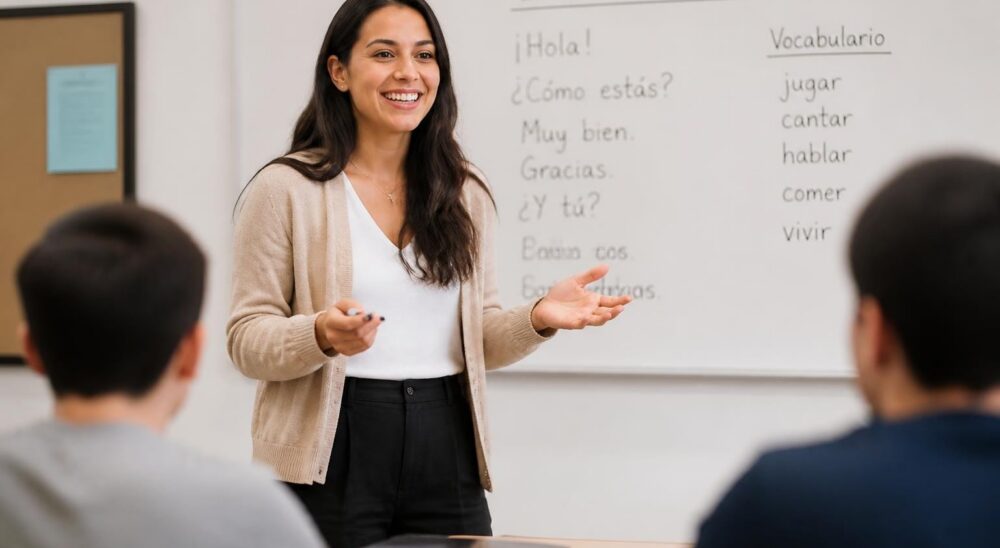
The role of a spanish teacher has evolved significantly in recent years, transforming from traditional classroom instruction to a dynamic blend of cultural immersion, technology integration, and personalised learning pathways. Whether you're considering a career in Spanish language instruction or seeking to understand what makes an exceptional educator, knowing the essential competencies and methodologies that define success in this field is crucial. In 2026, spanish teachers must balance linguistic expertise with technological fluency, cultural authenticity, and adaptive teaching strategies that meet learners wherever they are in their educational journey.
Essential Qualifications for Spanish Language Instruction
Becoming a competent spanish teacher requires more than native fluency or conversational ability. Professional credentials establish credibility and ensure instructional quality.
Academic and Professional Credentials
Most reputable language institutions require formal qualifications that demonstrate both subject mastery and pedagogical competence. A bachelor's degree in Spanish, linguistics, or education typically forms the foundation, whilst postgraduate qualifications in teaching languages as a foreign or additional language add specialised expertise.
Recognised certifications include:
- DELE (Diploma de Español como Lengua Extranjera) for Spanish proficiency
- Teaching English to Speakers of Other Languages (TESOL) adapted principles
- Postgraduate Certificate in Education (PGCE) with language specialism
- Masters in Applied Linguistics or Second Language Acquisition
Accreditation matters significantly. Working with institutions registered with educational authorities ensures quality standards and often provides pathways for professional development. The ACTFL Educator Resources hub offers valuable frameworks for language teaching proficiency.
Language Proficiency Levels
A spanish teacher should demonstrate superior proficiency across all four language domains: reading, writing, listening, and speaking. The Common European Framework of Reference (CEFR) provides standardised benchmarking, with C1 or C2 levels representing the advanced competence required for professional instruction.

| CEFR Level | Description | Teaching Capability |
|---|---|---|
| C2 | Mastery | Can teach all levels with nuanced cultural context |
| C1 | Advanced | Can teach up to upper-intermediate effectively |
| B2 | Upper-Intermediate | Suitable for basic to intermediate instruction |
| B1 and below | Intermediate or lower | Requires further development before teaching |
Core Competencies Every Spanish Teacher Should Master
Excellence in language instruction demands a diverse skill set that extends beyond grammatical knowledge.
Cultural Competence and Authenticity
A truly effective spanish teacher serves as a cultural ambassador, bringing the rich diversity of Spanish-speaking regions into every lesson. This means understanding regional variations between Castilian, Latin American, and other Spanish dialects, whilst also integrating customs, history, literature, and contemporary issues from across the Hispanic world.
Students learn languages more effectively when they understand the cultural context. Teaching about festivals like Día de los Muertos, historical movements, or regional cuisine transforms abstract vocabulary into lived experience. Research from the National Center for Biotechnology Information demonstrates how culturally embedded instruction improves retention and motivation.
Pedagogical Methodology and Differentiation
Modern language instruction employs communicative approaches that prioritise practical use over rote memorisation. The spanish teacher who succeeds in 2026 employs task-based learning, immersive conversation practice, and real-world application scenarios.
Effective methodologies include:
- Communicative Language Teaching (CLT) focusing on interaction
- Task-Based Language Teaching (TBLT) using authentic activities
- Content and Language Integrated Learning (CLIL) combining subject matter with language
- Total Physical Response (TPR) for kinesthetic learners
- Flipped classroom models for autonomous learning
Differentiation addresses the reality that learners have varying abilities, learning styles, and goals. Some students need Spanish for business negotiations, others for travel, and still others for academic research. Tailoring instruction to these diverse needs separates competent instructors from exceptional ones.
Technology Integration Skills
Digital literacy has become non-negotiable for language educators. A modern spanish teacher leverages platforms for virtual classrooms, utilises interactive applications for vocabulary building, and employs multimedia resources to create engaging learning environments.
Technology enables personalised learning at scale. Adaptive learning software adjusts difficulty based on student performance, whilst video conferencing tools connect learners with native speakers worldwide. Assessment platforms provide immediate feedback, and digital portfolios track progress over time.
Developing Effective Lesson Plans and Curriculum
Strategic planning ensures comprehensive coverage whilst maintaining student engagement throughout the learning journey.
Structured Progression and Learning Objectives
Each lesson should build systematically upon previous knowledge, with clear objectives aligned to recognised proficiency frameworks. A spanish teacher maps out progression from basic greetings and essential phrases through complex grammatical structures and sophisticated discourse.
Sample progression structure:
| Stage | Duration | Focus Areas | Proficiency Target |
|---|---|---|---|
| Foundation | 12-16 weeks | Present tense, essential vocabulary, basic conversation | A1-A2 |
| Development | 16-20 weeks | Past/future tenses, expanded vocabulary, cultural context | A2-B1 |
| Intermediate | 20-24 weeks | Subjunctive mood, idiomatic expressions, reading comprehension | B1-B2 |
| Advanced | 24+ weeks | Nuanced grammar, literary analysis, professional Spanish | B2-C1 |
Balancing Grammar, Vocabulary, and Conversation
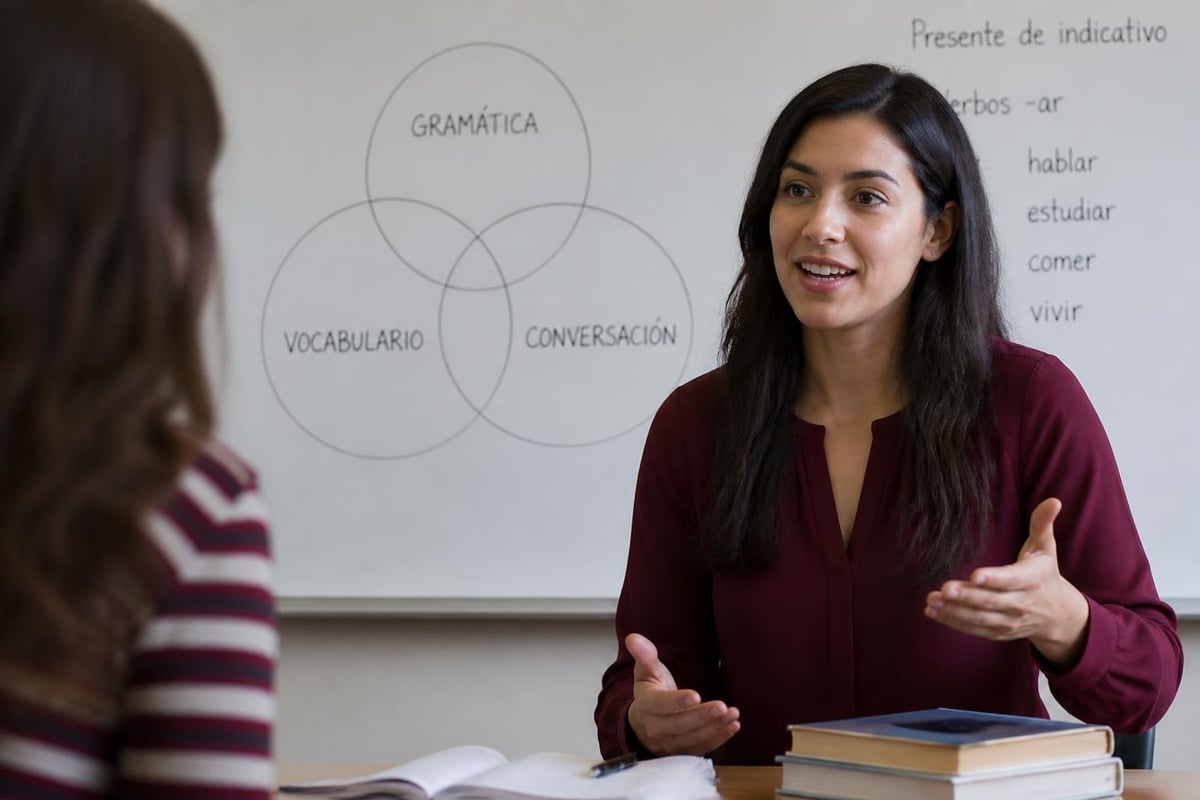
Traditional language instruction often overemphasised grammar at the expense of practical communication. Contemporary spanish teachers integrate these elements holistically, using grammatical structures as tools for meaningful expression rather than isolated rules to memorise.
Vocabulary acquisition works best when words are learned in context through thematic units. Teaching food vocabulary whilst discussing traditional recipes, or business terms through mock negotiations, creates memorable associations that facilitate recall.
Conversation practice should begin from the first lesson, even if initially limited to simple exchanges. Building confidence in spoken Spanish early prevents the common pitfall of students who can read and write competently but freeze when speaking.
Assessment Methods and Student Progress Tracking
Measuring advancement ensures students remain on track whilst identifying areas requiring additional focus.
Formative and Summative Evaluation
Formative assessment occurs continuously throughout instruction, providing ongoing feedback that guides both teaching and learning. A spanish teacher might use quick verbal checks, peer conversations, or short written exercises to gauge comprehension during each session.
Summative assessments evaluate cumulative learning at specific intervals. These include:
- Formal examinations testing all four language skills
- Oral presentations demonstrating conversational ability
- Written compositions showcasing grammatical accuracy
- Listening comprehension tests using authentic materials
- Reading comprehension exercises with cultural texts
Individualised Feedback Mechanisms
Generic praise or correction offers limited value. Specific, actionable feedback helps students understand precisely what they've mastered and where improvement is needed. A spanish teacher might note: "Your use of the preterite tense was accurate in describing completed actions, but remember to use the imperfect for ongoing past states or habitual actions."
Digital tools facilitate detailed tracking, allowing educators to monitor individual student trajectories and adjust instruction accordingly. Portfolio systems document growth over time, providing tangible evidence of progress that motivates continued effort.
Creating Engaging and Immersive Learning Environments
Environment significantly influences learning outcomes, whether in physical classrooms or virtual spaces.
Immersive Classroom Strategies
Maximum Spanish exposure accelerates acquisition. The most effective spanish teacher conducts lessons predominantly or entirely in the target language, using comprehensible input techniques that make meaning clear through context, gesture, and visual support.
Physical or virtual classroom spaces should reflect Hispanic culture through posters, music, authentic materials, and decorative elements. Creating a Spanish-speaking environment helps students mentally transition into language-learning mode.
Interactive activities break the monotony of lecture-style instruction:
- Role-playing scenarios (restaurant ordering, job interviews, travel situations)
- Language games and competitions
- Music and film analysis
- Collaborative projects requiring Spanish communication
- Virtual exchanges with native speakers
Online and Hybrid Instruction Models
Remote learning has permanently altered educational landscapes. Spanish teachers now need competence in delivering high-quality instruction through digital platforms whilst maintaining the personal connection essential for language learning.
Spanish & Portuguese online Language courses demonstrate how flexible, accessible instruction can reach students worldwide without compromising quality. Online formats particularly benefit working professionals, travellers preparing for relocation, and students in regions with limited local language education options.

Hybrid models combining synchronous virtual sessions with asynchronous independent study offer optimal flexibility. Students engage in live conversation practice and receive direct instruction during scheduled sessions, whilst completing vocabulary building, grammar exercises, and reading assignments independently.
Professional Development and Continuous Improvement
Language education evolves constantly, requiring ongoing learning from practitioners.
Staying Current with Pedagogical Research
Effective spanish teachers engage with current research on second language acquisition, cognitive linguistics, and educational psychology. Academic journals, professional conferences, and educator networks provide insights into emerging methodologies and evidence-based practices.
Professional associations offer valuable resources. The ACTFL Educator Resources provides curriculum frameworks, assessment guidelines, and teaching strategies grounded in research and proven through classroom application.
Building Networks and Collaborative Practice
Isolation limits growth. Connecting with fellow language educators through professional communities facilitates idea exchange, collaborative problem-solving, and mutual support. These networks might exist locally through educational institutions or globally through online platforms.
Mentorship relationships benefit both parties. Experienced spanish teachers share hard-won insights with newer colleagues, whilst fresh perspectives from emerging educators challenge established practitioners to reconsider assumptions and try innovative approaches.
Addressing Common Teaching Challenges
Every spanish teacher encounters obstacles that test their skills and resilience.
Managing Mixed-Ability Groups
Classrooms rarely contain students at identical proficiency levels. Some learners progress rapidly whilst others require additional time and support. Differentiated instruction addresses this reality through:
- Tiered activities offering varying complexity levels
- Flexible grouping that pairs stronger and weaker students strategically
- Extension activities for advanced learners who finish early
- Additional scaffolding and modified assessments for struggling students
- Individualised learning plans targeting specific needs
Maintaining Motivation Through Plateaus
Language acquisition isn't linear. Students often experience rapid initial progress followed by frustrating plateaus where advancement seems to stall. A skilled spanish teacher anticipates these phases and employs strategies to sustain motivation.
Celebrating small victories maintains momentum. Recognising improvements in pronunciation, successful use of a challenging grammatical structure, or growing confidence in conversation reminds students they're advancing even when progress feels slow.
Connecting language learning to personal goals reinforces purpose. Whether students aim to communicate with family members, advance their careers, enjoy travel more fully, or appreciate literature in its original language, regularly linking instruction to these aspirations sustains commitment through difficult periods.
Career Opportunities and Professional Pathways
Spanish instruction offers diverse career trajectories beyond traditional classroom teaching.
Educational Institutions and Private Practice
Schools, colleges, and universities employ spanish teachers in various capacities, from primary education through postgraduate programmes. These roles typically require formal teaching qualifications and offer structured career advancement, professional development support, and employment stability.
Private language schools provide alternatives with often more flexible working arrangements. Independent tutors build their own practices, setting their own schedules and rates whilst working directly with students. This pathway demands entrepreneurial skills alongside teaching expertise but offers autonomy and potentially higher earning capacity.
Corporate and Specialised Instruction
Businesses increasingly recognise language skills as competitive advantages, creating demand for spanish teachers who can deliver targeted instruction in corporate settings. Teaching business Spanish to executives, training customer service teams, or preparing employees for international assignments requires adapting general language instruction to specific professional contexts.
Specialised niches include:
- Medical Spanish for healthcare professionals
- Legal Spanish for attorneys and court personnel
- Technical Spanish for engineers and IT professionals
- Tourism and hospitality Spanish for service industry workers
- Academic Spanish for researchers and graduate students
Building a Rewarding Teaching Practice
Success requires more than technical competence; it demands passion, patience, and genuine investment in student success.
Developing Your Teaching Philosophy
Articulating your educational philosophy clarifies your approach and guides decision-making. Consider what you believe about how people learn languages most effectively, what role the teacher should play, how to balance structure with flexibility, and what success means beyond test scores.
Your philosophy evolves through experience and reflection. Regularly examining what works, what doesn't, and why helps refine your practice and deepen your effectiveness as a spanish teacher.
Cultivating Cultural Authenticity
Language and culture are inseparable. Teaching Spanish whilst ignoring the vibrant cultures of Spain, Mexico, Argentina, Colombia, and other Spanish-speaking regions reduces a living, breathing means of human connection to mere grammar and vocabulary lists.
Authenticity means more than token cultural references. It requires genuine engagement with Hispanic literature, music, film, history, and contemporary issues. It means acknowledging the diversity within the Spanish-speaking world rather than presenting a monolithic "Spanish culture."
Mastering the competencies outlined above positions you for success whether you're embarking on a teaching career or seeking to enhance your existing practice. The spanish teacher who combines linguistic expertise with cultural authenticity, pedagogical skill, and genuine passion for student growth creates transformative learning experiences that extend far beyond language acquisition. Mi Casa of Languages brings together these elements through accredited, flexible instruction that meets students wherever they are in their learning journey, delivering proven results through personalised, accessible Spanish and Portuguese education across South Africa and worldwide.





Recent Comments