



Learning Portuguese has become increasingly vital for professionals, travellers and individuals planning relocation to Portuguese-speaking countries. The rise of digital education has transformed how students access quality instruction, making Portuguese online classes a practical solution for busy schedules and diverse learning needs. Whether preparing for the Golden Visa programme in Portugal, building business connections in Brazil, or exploring cultural heritage, online learning platforms now deliver comprehensive language education that rivals traditional classroom experiences.
The Growing Demand for Portuguese Language Education
Portuguese ranks as the sixth most spoken language globally, with over 260 million speakers across four continents. This widespread use creates substantial demand for quality instruction, particularly amongst entrepreneurs expanding into Lusophone markets and families planning international relocation.
The linguistic landscape has shifted considerably since 2020, when remote instruction became essential rather than optional. Today's learners expect flexible scheduling and accessible formats that accommodate professional commitments and personal responsibilities.
Market Drivers for Online Portuguese Learning
Several key factors fuel the expansion of digital Portuguese education:
- Immigration and citizenship programmes requiring language proficiency documentation
- Corporate expansion into Brazilian and Portuguese markets
- Academic requirements for university programmes in Portuguese-speaking nations
- Heritage connection amongst diaspora communities maintaining family ties
- Tourism preparation for meaningful cultural experiences
The Department of Education's registration standards ensure that accredited institutions maintain high-quality instruction across all delivery formats. This regulatory framework provides learners with confidence in credential recognition and programme integrity.

Structural Advantages of Portuguese Online Classes
Digital delivery formats offer distinct benefits that traditional classroom settings cannot match. Understanding these advantages helps learners maximise their investment in language education.
Flexibility and Accessibility
Portuguese online classes eliminate geographical barriers and scheduling conflicts. Students in Johannesburg can access the same expert instruction as those in Cape Town or Durban, whilst working professionals fit lessons around demanding careers.
This accessibility extends beyond South Africa's borders. International learners pursuing Portuguese for Golden Visa requirements or business expansion access qualified instruction without relocation or extensive travel. The convenience factor proves particularly valuable for parents balancing childcare responsibilities with educational goals.
| Learning Format | Scheduling Flexibility | Geographic Access | Cost Efficiency | Personalisation Options |
|---|---|---|---|---|
| Online Classes | High – 24/7 options | Global reach | Lower overhead | Individual pacing |
| Traditional Classroom | Fixed timetables | Local only | Higher facility costs | Group-paced |
| Hybrid Models | Moderate flexibility | Regional | Mid-range | Limited customisation |
Technological Enhancement of Learning Outcomes
Modern platforms integrate multimedia resources that enrich the learning experience. Video conferencing enables real-time conversation practice, whilst screen-sharing facilitates collaborative document review and grammar instruction.
Research from institutions like the Camões Institute demonstrates that structured online programmes achieve comparable or superior outcomes to face-to-face instruction when properly designed. Interactive exercises, immediate feedback mechanisms and spaced repetition algorithms optimise retention and skill development.
Digital tools also enable precise progress tracking. Students monitor their advancement through proficiency levels, whilst instructors adjust teaching strategies based on performance data. This evidence-based approach ensures consistent movement towards fluency goals.
Selecting Quality Portuguese Online Classes
Not all digital language programmes offer equivalent value or effectiveness. Discerning learners should evaluate several critical factors before committing time and resources.
Accreditation and Institutional Recognition
Verify that your chosen provider holds proper accreditation from recognised educational authorities. In South Africa, registration with the Department of Education signals compliance with quality standards and curriculum requirements. This official recognition matters significantly for students requiring documented proof of language competency.
University partnerships provide additional validation of programme quality. Institutions collaborating with major universities typically maintain rigorous academic standards and employ qualified instructors with proven teaching credentials.
The Spanish & Portuguese online Language courses offered by accredited schools ensure learners receive instruction that meets international proficiency frameworks whilst remaining accessible to diverse student populations.

Instructor Qualifications and Teaching Methods
Effective language instruction requires more than native fluency. Professional educators possess pedagogical training, cultural knowledge and experience adapting methods to individual learning styles.
Investigate instructor backgrounds carefully:
- Academic credentials in linguistics, education or related fields
- Teaching certifications specific to Portuguese language instruction
- Cultural expertise reflecting real-world language usage
- Technology proficiency for effective online delivery
- Student success records demonstrating consistent outcomes
The automated assessment tools emerging in 2026 provide objective evaluation of speaking proficiency, though human instructors remain essential for nuanced feedback and cultural context.
Curriculum Design for Online Portuguese Instruction
Comprehensive programmes balance multiple competencies whilst maintaining learner engagement through varied activities and practical application.
Core Competency Development
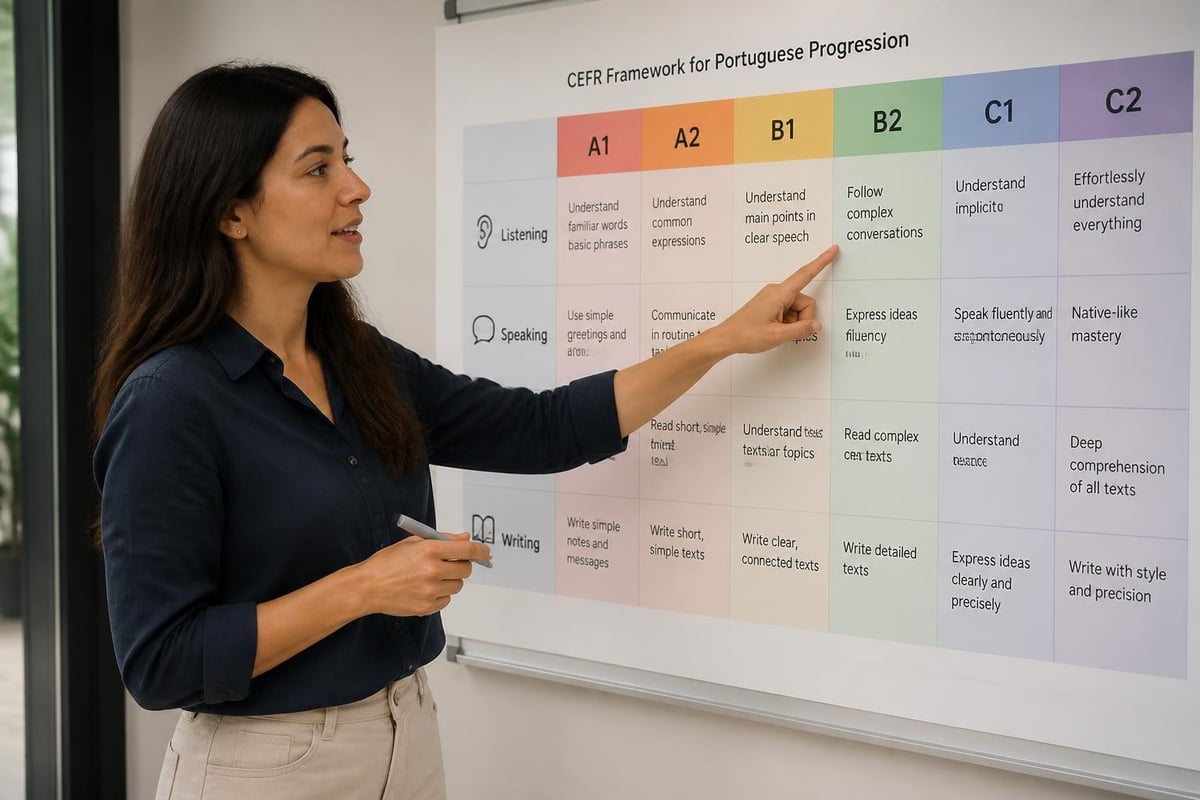
Effective Portuguese online classes address four fundamental skill areas:
Speaking and Pronunciation: Real-time conversation practice develops oral fluency and accent refinement. Video sessions enable instructors to observe mouth positioning and provide immediate correction.
Listening Comprehension: Exposure to diverse accents, speaking speeds and contexts prepares learners for authentic communication. Podcasts, news clips and film excerpts supplement structured listening exercises.
Reading Proficiency: Progressive text complexity builds vocabulary and grammar understanding. Materials range from beginner dialogues to advanced literature and professional documents.
Writing Accuracy: Structured composition practice develops formal and informal writing skills. Peer review and instructor feedback refine grammatical precision and stylistic appropriateness.
Cultural Integration and Practical Application
Language exists within cultural context. Quality programmes integrate cultural education alongside linguistic instruction, exploring social norms, business etiquette and regional variations between European Portuguese and Brazilian variants.
Practical application exercises simulate real-world scenarios:
- Business negotiations and professional correspondence
- Travel situations and emergency communication
- Social interactions and informal conversation
- Academic presentations and research discussions
- Legal documentation and official processes
This contextual learning ensures students can navigate actual situations rather than merely completing abstract exercises.
Technology Platforms and Learning Tools
The infrastructure supporting Portuguese online classes significantly impacts learning effectiveness. Modern platforms combine synchronous and asynchronous elements for optimal flexibility.
Synchronous Learning Components
Live video sessions form the core of interactive instruction. Platforms like Zoom, Microsoft Teams or specialised education software enable face-to-face conversation practice, immediate question resolution and collaborative activities.
Breakout rooms facilitate small-group practice, whilst screen-sharing supports visual learning and document collaboration. Recording capabilities allow students to review sessions and reinforce learning between classes.
Asynchronous Resources and Independent Study
Self-paced materials complement live instruction:
- Video libraries covering grammar concepts, pronunciation guides and cultural topics
- Interactive exercises providing immediate feedback and adaptive difficulty
- Mobile applications enabling practice during commute time or breaks
- Discussion forums fostering peer interaction and question-sharing
- Digital textbooks with embedded audio and supplementary resources
This blended approach accommodates different learning preferences whilst maximising schedule flexibility. Students access materials when concentration peaks rather than at fixed times determined by institutional timetables.
Assessment and Progress Measurement
Systematic evaluation ensures learners advance towards fluency whilst identifying areas requiring additional focus. Portuguese online classes incorporate multiple assessment methods for comprehensive progress tracking.
Formative Assessment Strategies
Ongoing evaluation throughout the course provides continuous feedback:
| Assessment Type | Frequency | Purpose | Format |
|---|---|---|---|
| Conversation practice | Weekly | Oral fluency development | Live dialogue |
| Vocabulary quizzes | Bi-weekly | Retention verification | Digital exercises |
| Writing assignments | Monthly | Composition skills | Essay submission |
| Listening comprehension | Weekly | Auditory processing | Audio + questions |
| Cultural knowledge | Quarterly | Context understanding | Project-based |
These regular checkpoints enable instructors to adjust pacing and teaching emphasis based on individual progress patterns.
Summative Evaluation and Certification
Formal assessments at course completion document achieved proficiency levels. Alignment with the Common European Framework of Reference (CEFR) ensures international recognition of credentials.
Students pursuing Golden Visa applications, university admission or professional certification require documented proof of language competency. Accredited institutions provide official certificates accepted by immigration authorities, educational institutions and employers across Portuguese-speaking nations.
The peer-reviewed research on remote learning outcomes confirms that properly structured online assessment maintains validity and reliability comparable to traditional testing formats.
Addressing Common Challenges in Online Language Learning
Digital instruction presents unique obstacles that successful learners anticipate and overcome through strategic approaches and appropriate support systems.
Maintaining Motivation and Consistency
The flexibility of Portuguese online classes requires strong self-discipline. Without physical classroom attendance, some students struggle with consistent participation.
Effective strategies include:
- Scheduled study blocks treated as non-negotiable appointments
- Accountability partners or study groups for mutual encouragement
- Clear milestone goals providing regular achievement recognition
- Varied learning activities preventing monotony and boredom
- Progress visualisation through tracking tools and competency logs
Institutions can support motivation through regular instructor contact, engaging curriculum design and community-building amongst enrolled students.
Technical Requirements and Digital Literacy
Successful participation requires reliable internet connectivity, appropriate devices and basic technology skills. Learners should verify technical prerequisites before enrolment.
Most Portuguese online classes function adequately with:
- Broadband internet connection (minimum 5 Mbps)
- Computer or tablet with webcam and microphone
- Updated web browser or learning platform application
- Quiet study space with minimal background noise
- Headphones for improved audio quality
Technical support services help students troubleshoot connectivity issues and navigate learning platforms, ensuring technology enhances rather than hinders the educational experience.
Optimising Your Portuguese Online Learning Journey
Strategic approaches maximise the return on time and financial investment in language education. Successful learners implement deliberate practices that accelerate progress and deepen comprehension.
Immersion Beyond Formal Lessons
Supplement structured instruction with authentic Portuguese exposure:
- Media consumption: News broadcasts, podcasts, films and television series
- Social media engagement: Following Portuguese-language accounts and creators
- Language exchange: Conversation partners for informal practice
- Reading materials: Newspapers, blogs and literature matching proficiency level
- Music and lyrics: Songs providing vocabulary and cultural insight
This extended exposure accelerates comprehension development and familiarises learners with colloquial expressions absent from textbooks.
Setting Realistic Expectations and Timelines
Language acquisition requires sustained effort over months or years. Understanding typical progression timelines prevents discouragement:
- A1-A2 (Basic User): 100-200 hours for survival communication
- B1-B2 (Independent User): 400-600 hours for professional competence
- C1-C2 (Proficient User): 800-1200 hours for native-like mastery
These estimates assume consistent study and practice. Learners with prior Romance language experience or intensive immersion may progress more rapidly, whilst those studying alongside demanding careers might require extended timelines.
Checking student testimonials provides realistic insights into the learning journey and outcomes achieved by previous students.
The Portuguese Variants: European Versus Brazilian
Portuguese online classes should address the significant differences between European and Brazilian variants. These distinctions extend beyond accent to encompass vocabulary, grammar and pronunciation patterns.
Selecting Your Target Variant
Choose based on your specific objectives:
European Portuguese suits learners planning:
- Relocation to Portugal (Golden Visa, retirement, employment)
- Business operations in Portugal or Lusophone Africa
- Academic study at Portuguese universities
- Formal certification examinations
Brazilian Portuguese benefits those pursuing:
- Brazilian business opportunities or employment
- Cultural engagement with Brazilian media and literature
- Travel throughout Brazil
- Connection with Brazilian communities
Quality programmes acknowledge these differences whilst teaching transferable foundational skills. Advanced learners may study both variants to maximise communication flexibility across Portuguese-speaking regions.
Regional Variations Within Variants
Both major variants contain regional accents and vocabulary differences. Brazilian Portuguese varies considerably between São Paulo, Rio de Janeiro and northeastern states, whilst European Portuguese differs between Lisbon, Porto and island territories.
Comprehensive Portuguese online classes expose students to multiple accents through diverse audio materials, ensuring comprehension across regions rather than single-locality fluency.
Investment and Affordability Considerations
Language education represents both financial investment and time commitment. Understanding cost structures helps learners select programmes offering optimal value.
Pricing Models and Course Structures
Portuguese online classes typically employ several pricing approaches:
- Hourly rates: Pay-per-session flexibility for irregular schedules
- Package deals: Bulk lesson purchases at discounted rates
- Subscription models: Monthly or quarterly fees for unlimited access
- Intensive programmes: Condensed timeframes at premium pricing
- Group versus individual: Shared classes reducing per-student costs
Affordable options exist across quality tiers. Accredited schools often provide excellent instruction at reasonable rates by eliminating facility overhead and optimising instructor schedules across time zones.
Calculating Total Investment and Expected Outcomes
Beyond tuition fees, consider supplementary costs:
- Course materials and textbooks
- Assessment and certification fees
- Technology requirements or upgrades
- Optional immersion activities or cultural events
Compare total investment against expected outcomes. Professional advancement, successful relocation or business expansion often justify significant educational expenditure through future returns.
Explore course offerings to understand pricing structures and available programme options.
Portuguese online classes provide accessible, flexible and effective pathways to language proficiency for learners worldwide. By selecting accredited programmes with qualified instructors, comprehensive curricula and appropriate technology platforms, students achieve fluency goals whilst accommodating busy schedules and diverse learning needs. Mi Casa of Languages, as South Africa's only accredited Portuguese language school registered with the Department of Education, offers worldwide access to expert instruction with proven success rates, tailoring courses to individual availability whilst maintaining the highest educational standards for learners pursuing personal, professional or relocation objectives.





Recent Comments